
Ch. 10 - Sequences and Infinite Series
Briggs - Calculus: Early Transcendentals 3rd Edition
Briggs3rd EditionCalculus: Early TranscendentalsISBN: 9780136847243당신이 사용하는 게 아니라요?교과서 변경
10장, 문제 10.1.31b

27–34. Working with sequences Several terms of a sequence {aₙ}ₙ₌₁∞ are given.
b. Find a recurrence relation that generates the sequence (supply the initial value of the index and the first term of the sequence).


{1, 3, 9, 27, 81, ......}

검증된 단계별 안내
1
Identify the pattern in the given sequence: {1, 3, 9, 27, 81, ...}. Notice how each term relates to the previous term.
Observe that each term is obtained by multiplying the previous term by 3. For example, 3 = 1 \(\times\) 3, 9 = 3 \(\times\) 3, and so on.
Express this relationship as a recurrence relation: \[a_{n} = 3 \times a_{n-1}\] where \[n \geq 2\].
Specify the initial condition, which is the first term of the sequence: \[a_1 = 1\].
Combine the recurrence relation and the initial condition to fully define the sequence: \[a_1 = 1, \quad a_n = 3a_{n-1} \text{ for } n \geq 2\].

비슷한 문제에 대한 검증된 영상 답변:

이 영상 해법은 위 문제에 도움이 된다고 튜터들이 추천한 것입니다.
영상 길이:
2m
도움이 되었나요?

주요 개념

질문에 올바르게 답하기 위해 반드시 이해해야 하는 핵심 개념들은 다음과 같습니다.

Sequences and Terms

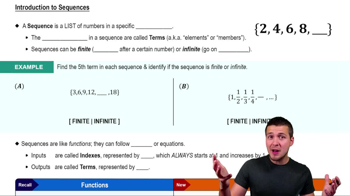
A sequence is an ordered list of numbers defined by a specific rule. Each number in the sequence is called a term, denoted as aₙ, where n indicates the term's position. Understanding how terms relate to their positions is essential for analyzing and generating sequences.
추천 영상:
8:22
Introduction to Sequences

Recurrence Relation

A recurrence relation expresses each term of a sequence as a function of one or more previous terms. It provides a way to generate the sequence step-by-step, starting from initial term(s). Identifying the recurrence relation helps in understanding the pattern and behavior of the sequence.
추천 영상:
가이드 코스
04:16
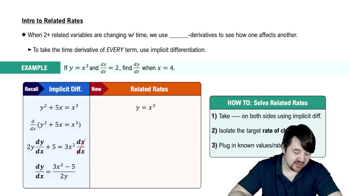
Intro To Related Rates

Initial Conditions

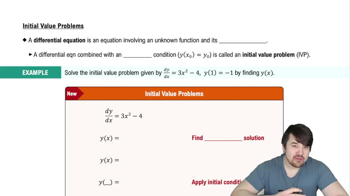
Initial conditions specify the starting term(s) of a sequence, which are necessary to uniquely determine all subsequent terms using the recurrence relation. Without these values, the sequence cannot be fully generated or analyzed.
추천 영상:
가이드 코스
05:03
Initial Value Problems
관련 실천
교과서 질문

67–70. Formulas for sequences of partial sums Consider the following infinite series.


b.Find a formula for the nth partial sum Sₙ of the infinite series. Use this formula to find the next four partial sums S₅, S₆, S₇, S₈ of the infinite series.


∑⁽∞⁾ₖ₌₁2⁄[(2k − 1)(2k + 1)]

90
views
교과서 질문

Explain why or why not Determine whether the following statements are true and give an explanation or counterexample.


b. (2n)! / (2n − 1)! = 2n

61
views
교과서 질문

Suppose the sequence {aₙ}⁽∞⁾ₙ₌₀ is defined by the recurrence relation

aₙ₊₁ = ⅓aₙ + 6;a₀ = 3.


b.Explain why {aₙ}⁽∞⁾ₙ₌₀ converges and find the limit.

36
views
교과서 질문

57–60. Heights of bouncing balls A ball is thrown upward to a height of hₒ meters. After each bounce, the ball rebounds to a fraction r of its previous height. Let hₙ be the height after the nth bounce. Consider the following values of hₒ and r.


b. Find an explicit formula for the nth term of the sequence {hₙ}.


h₀ = 20,r = 0.5

82
views
교과서 질문

87. Explain why or why not

Determine whether the following statements are true and give an explanation or counterexample.


b. If ∑ (k = 1 to ∞) aₖ diverges, then ∑ (k = 10 to ∞) aₖ diverges.

46
views
교과서 질문

39–40. {Use of Tech} Lower and upper bounds of a series

For each convergent series and given value of n, use Theorem 10.13 to complete the following.


b. Find an upper bound for the remainder Rₙ.


39. ∑ (k = 1 to ∞) 1 / k⁷ ; n = 2

120
views