Ch. 10 - Sequences and Infinite Series
Briggs - Calculus: Early Transcendentals 3rd Edition
Briggs3rd EditionCalculus: Early TranscendentalsISBN: 9780136847243당신이 사용하는 게 아니라요?교과서 변경
10장, 문제 10.1.67b

67–70. Formulas for sequences of partial sums Consider the following infinite series.


b.Find a formula for the nth partial sum Sₙ of the infinite series. Use this formula to find the next four partial sums S₅, S₆, S₇, S₈ of the infinite series.


∑⁽∞⁾ₖ₌₁2⁄[(2k − 1)(2k + 1)]

검증된 단계별 안내
1
Start by writing the nth partial sum of the series as the sum of the first n terms: \(S_n = \sum_{k=1}^n \frac{2}{(2k - 1)(2k + 1)}\).
Use partial fraction decomposition to rewrite the general term \(\frac{2}{(2k - 1)(2k + 1)}\) in a form that will allow telescoping. Set \(\frac{2}{(2k - 1)(2k + 1)} = \frac{A}{2k - 1} + \frac{B}{2k + 1}\) and solve for A and B.
After finding A and B, rewrite each term of the sum using these partial fractions. This should create a telescoping series where most terms cancel out when summed.
Express \(S_n\) as a simplified expression after cancellation, which will be a formula involving only a few terms depending on n.
Use the formula for \(S_n\) to calculate the next four partial sums: \(S_5\), \(S_6\), \(S_7\), and \(S_8\) by substituting n = 5, 6, 7, and 8 respectively.

비슷한 문제에 대한 검증된 영상 답변:

이 영상 해법은 위 문제에 도움이 된다고 튜터들이 추천한 것입니다.
영상 길이:
6m

주요 개념

질문에 올바르게 답하기 위해 반드시 이해해야 하는 핵심 개념들은 다음과 같습니다.

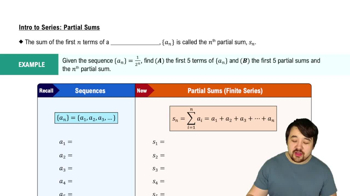
Partial Sums of a Series

A partial sum Sₙ is the sum of the first n terms of a series. It helps approximate the value of an infinite series by adding a finite number of terms. Understanding partial sums is essential to analyze convergence and to find explicit formulas for sums up to a certain index.
추천 영상:
가이드 코스
06:45
Intro to Series: Partial Sums

Telescoping Series

A telescoping series is one where many terms cancel out when the partial sums are expanded. This simplification often allows finding a closed-form expression for Sₙ. Recognizing telescoping patterns is key to simplifying complex series like the given one.
추천 영상:
가이드 코스
06:00
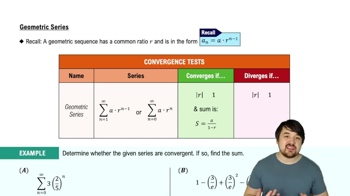
Geometric Series

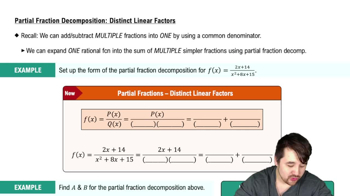
Decomposition into Partial Fractions

Partial fraction decomposition breaks a complex rational expression into simpler fractions. This technique is useful to rewrite terms in a series to reveal telescoping behavior. Applying it to the given term helps in finding a formula for the nth partial sum.
추천 영상:
가이드 코스
10:07
Partial Fraction Decomposition: Distinct Linear Factors
관련 실천
교과서 질문

41–44. {Use of Tech} Remainders and estimates Consider the following convergent series.


b. Find how many terms are needed to ensure that the remainder is less than 10⁻³.


43. ∑ (k = 1 to ∞) 1 / 3ᵏ

134
views

교과서 질문

27–34. Working with sequences Several terms of a sequence {aₙ}ₙ₌₁∞ are given.

b. Find a recurrence relation that generates the sequence (supply the initial value of the index and the first term of the sequence).


{1, 3, 9, 27, 81, ......}

52
views
교과서 질문

Suppose the sequence {aₙ}⁽∞⁾ₙ₌₀ is defined by the recurrence relation

aₙ₊₁ = ⅓aₙ + 6;a₀ = 3.


b.Explain why {aₙ}⁽∞⁾ₙ₌₀ converges and find the limit.

36
views
교과서 질문

Loglog p-series Consider the series ∑ (k = 2 to ∞) 1 / (k(ln k)(ln ln k)ᵖ), where p is a real number.

b. Which of the following series converges faster? Explain.

∑ (k = 2 to ∞) 1 / (k(ln k)²) or ∑ (k = 3 to ∞) 1 / (k(ln k)(ln ln k)²)?

50
views
교과서 질문

72–75. {Use of Tech} Practical sequences

Consider the following situations that generate a sequence


b.Find an explicit formula for the terms of the sequence.


Drug elimination

Jack took a 200-mg dose of a pain killer at midnight. Every hour, 5% of the drug is washed out of his bloodstream. Let dₙ be the amount of drug in Jack’s blood n hours after the drug was taken, where d₀ = 200mg.

48
views
교과서 질문

Explain why or why not Determine whether the following statements are true and give an explanation or counterexample.


b. A series that converges absolutely must converge.

64
views