Ch. 10 - Sequences and Infinite Series
Briggs - Calculus: Early Transcendentals 3rd Edition
Briggs3rd EditionCalculus: Early TranscendentalsISBN: 9780136847243당신이 사용하는 게 아니라요?교과서 변경
10장, 문제 10.R.61

42–76. Convergence or divergence Use a convergence test of your choice to determine whether the following series converge.
∑ (from k = 3 to ∞)ln(k) / k³ᐟ²

검증된 단계별 안내
1
Identify the series given: \( \sum_{k=3}^{\infty} \frac{\ln(k)}{k^{3/2}} \). We want to determine if this series converges or diverges.
Consider the behavior of the terms \( a_k = \frac{\ln(k)}{k^{3/2}} \) as \( k \to \infty \). Since \( \ln(k) \) grows slowly and \( k^{3/2} \) grows faster, the terms approach zero, which is necessary for convergence but not sufficient.
Choose a convergence test suitable for series with positive terms and involving logarithms and powers. The Comparison Test or the Limit Comparison Test are good candidates here.
Compare \( a_k \) with a simpler series \( b_k = \frac{1}{k^{3/2}} \), which is a p-series with \( p = \frac{3}{2} > 1 \) and is known to converge.
Apply the Limit Comparison Test by evaluating \( \lim_{k \to \infty} \frac{a_k}{b_k} = \lim_{k \to \infty} \frac{\ln(k)/k^{3/2}}{1/k^{3/2}} = \lim_{k \to \infty} \ln(k) \). Since this limit diverges to infinity, refine the approach by noting that \( \ln(k) \) grows slower than any power of \( k \), so the original series behaves similarly to the convergent p-series, indicating convergence.

비슷한 문제에 대한 검증된 영상 답변:

이 영상 해법은 위 문제에 도움이 된다고 튜터들이 추천한 것입니다.
영상 길이:
4m

주요 개념

질문에 올바르게 답하기 위해 반드시 이해해야 하는 핵심 개념들은 다음과 같습니다.

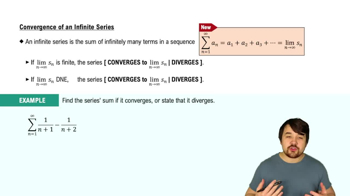
Convergence of Infinite Series

An infinite series converges if the sum of its terms approaches a finite limit as the number of terms grows indefinitely. Determining convergence involves analyzing the behavior of the terms and applying appropriate tests to see if the series sums to a finite value.
추천 영상:
가이드 코스
06:52
Convergence of an Infinite Series

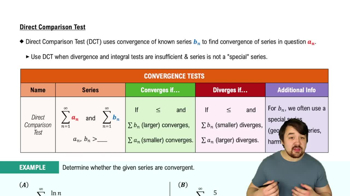
Comparison Test

The Comparison Test involves comparing the given series to a known benchmark series with positive terms. If the given series' terms are smaller than those of a convergent series, it also converges; if larger than a divergent series, it diverges. This test is useful when terms resemble simpler series.
추천 영상:
가이드 코스
09:25
Direct Comparison Test

Behavior of Logarithmic and Power Functions in Series

Understanding how logarithmic functions like ln(k) grow compared to power functions like k^(3/2) is crucial. Since ln(k) grows slower than any positive power of k, the term ln(k)/k^(3/2) behaves similarly to 1/k^(3/2) for large k, which helps in applying convergence tests effectively.
추천 영상:
07:32
Representing Functions as Power Series