Ch. 10 - Sequences and Infinite Series
Briggs - Calculus: Early Transcendentals 3rd Edition
Briggs3rd EditionCalculus: Early TranscendentalsISBN: 9780136847243당신이 사용하는 게 아니라요?교과서 변경
10장, 문제 10.R.33

27–37. Evaluating series Evaluate the following infinite series or state that the series diverges.
∑ (from k = 0 to ∞)(tan⁻¹(k + 2) − tan⁻¹k)

검증된 단계별 안내
1
Recognize that the series is given by the sum from k = 0 to infinity of the terms \( \tan^{-1}(k + 2) - \tan^{-1}(k) \). This is a telescoping series because each term is a difference of inverse tangent functions evaluated at consecutive points separated by 2.
Write out the first few partial sums explicitly to observe the telescoping pattern: \( S_n = \sum_{k=0}^n \left( \tan^{-1}(k + 2) - \tan^{-1}(k) \right) = (\tan^{-1}(2) - \tan^{-1}(0)) + (\tan^{-1}(3) - \tan^{-1}(1)) + \cdots + (\tan^{-1}(n+2) - \tan^{-1}(n)) \).
Group the terms in the partial sum to see which terms cancel out. Notice that many intermediate terms will cancel, leaving only a few terms from the beginning and the end of the sum.
Express the partial sum \( S_n \) in terms of the remaining terms after cancellation. Typically, for telescoping sums of this form, \( S_n = \tan^{-1}(n+1) + \tan^{-1}(n+2) - \tan^{-1}(0) - \tan^{-1}(1) \) or a similar expression depending on the exact cancellation pattern.
Evaluate the limit of the partial sums as \( n \to \infty \) to determine if the series converges. Use the fact that \( \lim_{x \to \infty} \tan^{-1}(x) = \frac{\pi}{2} \) to find the limit of \( S_n \). If the limit exists and is finite, the series converges to that value; otherwise, it diverges.

비슷한 문제에 대한 검증된 영상 답변:

이 영상 해법은 위 문제에 도움이 된다고 튜터들이 추천한 것입니다.
영상 길이:
5m
도움이 되었나요?

주요 개념

질문에 올바르게 답하기 위해 반드시 이해해야 하는 핵심 개념들은 다음과 같습니다.

Telescoping Series

A telescoping series is a series where many terms cancel out when expanded, leaving only a few terms from the beginning and end. This simplification helps in evaluating the sum of infinite series by reducing complex expressions to simpler forms.
추천 영상:
가이드 코스
06:00
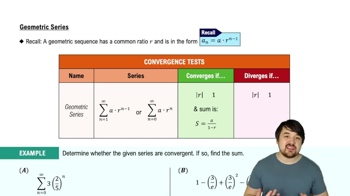
Geometric Series

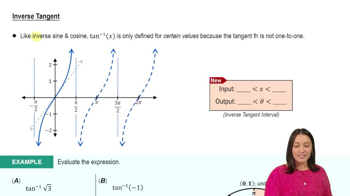
Properties of the Inverse Tangent Function (arctan)

The inverse tangent function, arctan(x), is continuous and monotonic, with known limits as x approaches infinity or negative infinity. Understanding its behavior helps in evaluating limits of terms like arctan(k+2) - arctan(k) as k grows large.
추천 영상:
3:17
Inverse Tangent

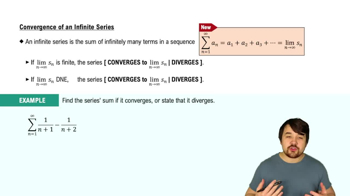
Convergence and Divergence of Infinite Series

An infinite series converges if the sequence of its partial sums approaches a finite limit; otherwise, it diverges. Determining convergence often involves analyzing term behavior and applying tests or simplifications like telescoping.
추천 영상:
가이드 코스
06:52
Convergence of an Infinite Series