Ch. 10 - Sequences and Infinite Series
Briggs - Calculus: Early Transcendentals 3rd Edition
Briggs3rd EditionCalculus: Early TranscendentalsISBN: 9780136847243당신이 사용하는 게 아니라요?교과서 변경
10장, 문제 10.R.83

77–87. Absolute or conditional convergence
Determine whether the following series converge absolutely, converge conditionally, or diverge.
∑ (from k = 1 to ∞)(−1)ᵏk·e⁻ᵏ

검증된 단계별 안내
1
Identify the given series: \( \sum_{k=1}^{\infty} (-1)^k k e^{-k} \). This is an alternating series because of the factor \( (-1)^k \).
To check for absolute convergence, consider the absolute value of the terms: \( \sum_{k=1}^{\infty} \left| (-1)^k k e^{-k} \right| = \sum_{k=1}^{\infty} k e^{-k} \).
Analyze the absolute value series \( \sum_{k=1}^{\infty} k e^{-k} \). Since \( e^{-k} = \frac{1}{e^k} \), the terms look like \( \frac{k}{e^k} \). Use a convergence test suitable for series with terms involving \( k \) and exponential decay, such as the Ratio Test.
Apply the Ratio Test to \( a_k = k e^{-k} \): compute \( \lim_{k \to \infty} \left| \frac{a_{k+1}}{a_k} \right| = \lim_{k \to \infty} \frac{(k+1) e^{-(k+1)}}{k e^{-k}} \) and simplify the expression to determine if the limit is less than 1.
If the absolute value series converges, then the original series converges absolutely. If it does not, check if the original alternating series converges by applying the Alternating Series Test, which requires that \( k e^{-k} \) decreases to zero as \( k \to \infty \).

비슷한 문제에 대한 검증된 영상 답변:

이 영상 해법은 위 문제에 도움이 된다고 튜터들이 추천한 것입니다.
영상 길이:
3m
도움이 되었나요?

주요 개념

질문에 올바르게 답하기 위해 반드시 이해해야 하는 핵심 개념들은 다음과 같습니다.

Absolute Convergence

A series ∑a_k converges absolutely if the series of absolute values ∑|a_k| converges. Absolute convergence guarantees convergence regardless of the sign of terms, and it implies the original series converges. Testing absolute convergence often involves comparison or ratio tests.
추천 영상:
가이드 코스
07:51
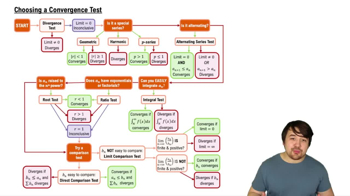
Choosing a Convergence Test

Conditional Convergence

A series converges conditionally if it converges, but does not converge absolutely. This means ∑a_k converges, but ∑|a_k| diverges. Conditional convergence often occurs in alternating series where the terms decrease in magnitude and approach zero.
추천 영상:
가이드 코스
07:51
Choosing a Convergence Test

Tests for Convergence of Series

To determine convergence, tests like the Ratio Test, Root Test, and Alternating Series Test are used. The Ratio Test is useful for series with exponential terms, while the Alternating Series Test applies to series with alternating signs and decreasing terms. These tests help classify the series as absolutely convergent, conditionally convergent, or divergent.
추천 영상:
가이드 코스
07:51
Choosing a Convergence Test