
Ch. 10 - Sequences and Infinite Series
Briggs - Calculus: Early Transcendentals 3rd Edition
Briggs3rd EditionCalculus: Early TranscendentalsISBN: 9780136847243당신이 사용하는 게 아니라요?교과서 변경
10장, 문제 10.R.19

12–24. Limits of sequences Evaluate the limit of the sequence or state that it does not exist.
aₙ = ((3n² + 2n + 1) · sin(n)) / (4n³ + n) (Hint: Use the Squeeze Theorem.)

검증된 단계별 안내
1
Identify the given sequence: \(a_n = \frac{(3n^2 + 2n + 1) \cdot \sin(n)}{4n^3 + n}\).
Analyze the behavior of the numerator and denominator separately as \(n\) approaches infinity. The numerator grows roughly like \$3n^2\( times \(\sin(n)\), and the denominator grows like \)4n^3$.
Note that \(\sin(n)\) oscillates between \(-1\) and \(1\), so \(-1 \leq \sin(n) \leq 1\). Use this to create inequalities for \(a_n\):
\[-\frac{3n^2 + 2n + 1}{4n^3 + n} \leq a_n \leq \frac{3n^2 + 2n + 1}{4n^3 + n}.\]
Simplify the bounding expressions by dividing numerator and denominator by \(n^3\) to understand their limits:
\[-\frac{3/n + 2/n^2 + 1/n^3}{4 + 1/n^2} \leq a_n \leq \frac{3/n + 2/n^2 + 1/n^3}{4 + 1/n^2}.\]
Apply the Squeeze Theorem: since both bounds approach \(0\) as \(n \to \infty\), conclude that \(\lim_{n \to \infty} a_n = 0\).

비슷한 문제에 대한 검증된 영상 답변:

이 영상 해법은 위 문제에 도움이 된다고 튜터들이 추천한 것입니다.
영상 길이:
3m
도움이 되었나요?

주요 개념

질문에 올바르게 답하기 위해 반드시 이해해야 하는 핵심 개념들은 다음과 같습니다.

Limits of Sequences

The limit of a sequence describes the value that the terms of the sequence approach as the index n goes to infinity. If the terms get arbitrarily close to a specific number, the sequence converges to that limit; otherwise, it diverges.
추천 영상:
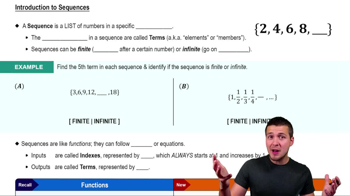
8:22
Introduction to Sequences

Squeeze Theorem

The Squeeze Theorem helps find limits by 'trapping' a sequence between two others that have the same limit. If aₙ ≤ bₙ ≤ cₙ for all n beyond some point, and both aₙ and cₙ converge to L, then bₙ also converges to L.
추천 영상:
가이드 코스
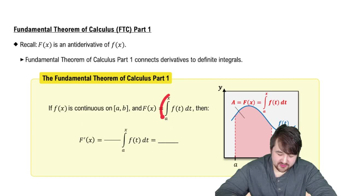
06:11
Fundamental Theorem of Calculus Part 1

Behavior of Trigonometric Functions in Limits

Trigonometric functions like sin(n) oscillate between -1 and 1 and do not have limits as n approaches infinity. When combined with sequences that tend to zero, their bounded nature allows the use of the Squeeze Theorem to evaluate the overall limit.
추천 영상:
가이드 코스
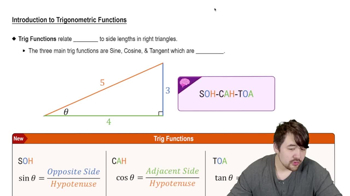
6:04
Introduction to Trigonometric Functions
관련 실천