
Ch. 11 - Power Series
Briggs - Calculus: Early Transcendentals 3rd Edition
Briggs3rd EditionCalculus: Early TranscendentalsISBN: 9780136847243당신이 사용하는 게 아니라요?교과서 변경
11장, 문제 11.4.35

Differential equations


a. Find a power series for the solution of the following differential equations, subject to the given initial condition
b. Identify the function represented by the power series.


y′(t) − 3y = 10, y(0) = 2

검증된 단계별 안내
1
Rewrite the differential equation in a standard form: \(y'(t) = 3y + 10\).
Assume the solution \(y(t)\) can be expressed as a power series centered at \(t=0\): \(y(t) = \sum_{n=0}^{\infty} a_n t^n\).
Differentiate the power series term-by-term to find \(y'(t) = \sum_{n=1}^{\infty} n a_n t^{n-1}\).
Substitute the series expressions for \(y(t)\) and \(y'(t)\) into the differential equation, and equate coefficients of like powers of \(t\) to form a recurrence relation for the coefficients \(a_n\).
Use the initial condition \(y(0) = 2\) to find \(a_0\), then use the recurrence relation to find subsequent coefficients \(a_n\), thus obtaining the power series solution. Finally, recognize the power series as a known function by comparing it to standard series expansions.

비슷한 문제에 대한 검증된 영상 답변:

이 영상 해법은 위 문제에 도움이 된다고 튜터들이 추천한 것입니다.
영상 길이:
10m

주요 개념

질문에 올바르게 답하기 위해 반드시 이해해야 하는 핵심 개념들은 다음과 같습니다.

Power Series Solutions to Differential Equations

A power series solution expresses the solution of a differential equation as an infinite sum of powers of the independent variable. This method is useful when solutions cannot be found using elementary functions. It involves assuming a solution in the form of a series and determining coefficients by substituting into the differential equation.
추천 영상:
05:58
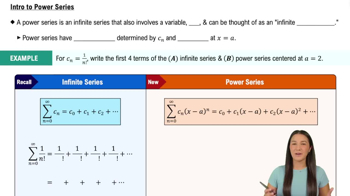
Intro to Power Series

Initial Conditions and Their Role

Initial conditions specify the value of the solution and possibly its derivatives at a particular point, allowing for the determination of unknown constants in the general solution. For power series, initial conditions help find the first coefficient(s) and ensure the solution matches the problem's requirements.
추천 영상:
가이드 코스
05:03
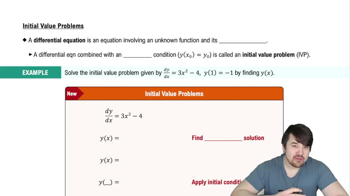
Initial Value Problems

Identifying Functions from Power Series

Once a power series solution is found, it can often be recognized as a known function by comparing it to standard series expansions (e.g., exponential, trigonometric). This identification simplifies understanding the solution's behavior and provides a closed-form expression.
추천 영상:
07:32
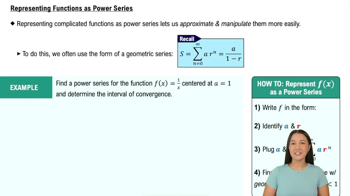
Representing Functions as Power Series
관련 실천
교과서 질문

Working with binomial series Use properties of power series, substitution, and factoring to find the first four nonzero terms of the Maclaurin series for the following functions. Give the interval of convergence for the new series (Theorem 11.4 is useful). Use the Maclaurin series


√(1 + x) = 1 + x/2 − x²/8 + x³/16 − ⋯, −1 ≤ x ≤ 1.


√(9 − 9x)

60
views
교과서 질문

Functions to power series Find power series representations centered at 0 for the following functions using known power series. Give the interval of convergence for the resulting series.

f(x) = ln √(1 − x²)

97
views
교과서 질문

Combining power series Use the power series representation


f(x ) =ln (1 − x) = −∑ₖ₌₁∞ xᵏ/k, for −1 ≤ x < 1,


to find the power series for the following functions (centered at 0). Give the interval of convergence of the new series.


f(3x) = ln (1 − 3x)

83
views
교과서 질문

The first three Taylor polynomials for f(x)=√(1+x) centered at 0 are p₀ = 1, p₁ = 1+x/2, and p₂ = 1 + x/2 − x²/8. Find three approximations to √1.1.

69
views
교과서 질문

Is ∑ₖ₌₀ ∞ (5x − 20)ᵏ a power series? If so, find the center a of the power series and state a formula for the coefficients cₖ of the power series.

67
views
교과서 질문

Use of Tech Linear and quadratic approximation


a. Find the linear approximating polynomial for the following functions centered at the given point a.


b. Find the quadratic approximating polynomial for the following functions centered at a.


c Use the polynomials obtained in parts (a) and (b) to approximate the given quantity.


f(x)=e⁻²ˣ, a=0; approximate e⁻⁰ᐧ².

56
views