Ch. 11 - Power Series
Briggs - Calculus: Early Transcendentals 3rd Edition
Briggs3rd EditionCalculus: Early TranscendentalsISBN: 9780136847243당신이 사용하는 게 아니라요?교과서 변경
11장, 문제 11.1.12

Use of Tech Linear and quadratic approximation


a. Find the linear approximating polynomial for the following functions centered at the given point a.


b. Find the quadratic approximating polynomial for the following functions centered at a.


c Use the polynomials obtained in parts (a) and (b) to approximate the given quantity.


f(x)=e⁻²ˣ, a=0; approximate e⁻⁰ᐧ².

검증된 단계별 안내
1
Identify the function and the point of approximation: here, the function is \(f(x) = e^{-2x}\) and the center point is \(a = 0\).
Find the value of the function at \(a\): calculate \(f(0) = e^{-2 \cdot 0} = e^0 = 1\).
Compute the first derivative \(f'(x)\) and evaluate it at \(a\): since \(f(x) = e^{-2x}\), then \(f'(x) = -2 e^{-2x}\), so \(f'(0) = -2 e^0 = -2\).
For the linear approximation (first-degree Taylor polynomial) centered at \(a=0\), use the formula: \(L(x) = f(a) + f'(a)(x - a)\), which becomes \(L(x) = 1 - 2(x - 0) = 1 - 2x\).
For the quadratic approximation (second-degree Taylor polynomial), compute the second derivative \(f''(x)\) and evaluate at \(a\): \(f''(x) = 4 e^{-2x}\), so \(f''(0) = 4\). Then use the formula \(Q(x) = f(a) + f'(a)(x - a) + \frac{f''(a)}{2}(x - a)^2\), which becomes \(Q(x) = 1 - 2x + 2x^2\). Finally, substitute \(x = 0.1\) (since \(e^{-0.2} = e^{-2 \cdot 0.1}\)) into both \(L(x)\) and \(Q(x)\) to approximate \(e^{-0.2}\).

비슷한 문제에 대한 검증된 영상 답변:

이 영상 해법은 위 문제에 도움이 된다고 튜터들이 추천한 것입니다.
영상 길이:
5m
도움이 되었나요?

주요 개념

질문에 올바르게 답하기 위해 반드시 이해해야 하는 핵심 개념들은 다음과 같습니다.

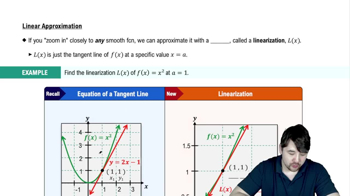
Linear Approximation (Linearization)

Linear approximation uses the tangent line at a point to estimate the value of a function near that point. It is given by L(x) = f(a) + f'(a)(x - a), where f'(a) is the derivative at a. This method simplifies complex functions to linear polynomials for easier calculation of nearby values.
추천 영상:

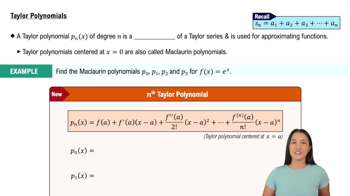
Quadratic Approximation (Second-Order Taylor Polynomial)

Quadratic approximation extends linearization by including the second derivative, providing a better estimate near the point a. It is expressed as Q(x) = f(a) + f'(a)(x - a) + (f''(a)/2)(x - a)^2, capturing curvature to improve accuracy over linear approximation.
추천 영상:
07:00
Taylor Polynomials

Using Approximations to Estimate Function Values

Once linear and quadratic polynomials are found, they can approximate function values at points close to a. This avoids complex calculations of the original function, especially for transcendental functions like e^(-2x), by substituting x into the simpler polynomial forms.
추천 영상:
가이드 코스
07:59
Estimating the Area Under a Curve Using Left Endpoints