
Ch. 11 - Power Series
Briggs - Calculus: Early Transcendentals 3rd Edition
Briggs3rd EditionCalculus: Early TranscendentalsISBN: 9780136847243당신이 사용하는 게 아니라요?교과서 변경
11장, 문제 11.3.67b

Explain why or why not Determine whether the following statements are true and give an explanation or counterexample.
b. The function f(x) = csc x has a Taylor series centered at π/2.

검증된 단계별 안내
1
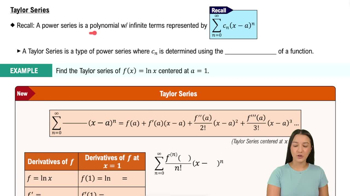
Recall that a Taylor series of a function \(f(x)\) centered at \(a\) is given by the infinite sum \(\sum_{n=0}^{\infty} \frac{f^{(n)}(a)}{n!} (x - a)^n\), where \(f^{(n)}(a)\) denotes the \(n\)-th derivative of \(f\) evaluated at \(x = a\).
To determine if \(f(x) = \csc x\) has a Taylor series centered at \(x = \frac{\pi}{2}\), first check if \(f\) is differentiable at \(x = \frac{\pi}{2}\) and in some open interval around it.
Evaluate \(f\left(\frac{\pi}{2}\right) = \csc\left(\frac{\pi}{2}\right) = 1\), which is finite, so the function is defined at \(x = \frac{\pi}{2}\).
Next, consider the behavior of \(\csc x\) near \(x = \frac{\pi}{2}\). Since \(\sin x\) is nonzero and smooth around \(\frac{\pi}{2}\), \(\csc x = \frac{1}{\sin x}\) is also smooth and infinitely differentiable there.
Therefore, \(f(x) = \csc x\) is infinitely differentiable at \(x = \frac{\pi}{2}\), so it does have a Taylor series centered at \(\frac{\pi}{2}\). The Taylor series converges to \(f(x)\) in some interval around \(\frac{\pi}{2}\) where \(\sin x \neq 0\).

비슷한 문제에 대한 검증된 영상 답변:

이 영상 해법은 위 문제에 도움이 된다고 튜터들이 추천한 것입니다.
영상 길이:
4m
도움이 되었나요?

주요 개념

질문에 올바르게 답하기 위해 반드시 이해해야 하는 핵심 개념들은 다음과 같습니다.

Taylor Series and Center of Expansion

A Taylor series represents a function as an infinite sum of derivatives at a specific point called the center. The series converges to the function near this point if the function is sufficiently smooth and differentiable there. Understanding the center is crucial to determine if the series exists and converges.
추천 영상:
08:42
Taylor Series

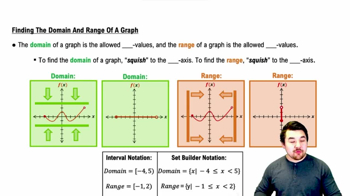
Domain and Differentiability of csc(x)

The function csc(x) = 1/sin(x) is undefined where sin(x) = 0, causing vertical asymptotes. For a Taylor series to exist at a point, the function must be defined and infinitely differentiable there. Checking if csc(x) is defined and smooth at π/2 is essential.
추천 영상:
가이드 코스
5:10
Finding the Domain and Range of a Graph

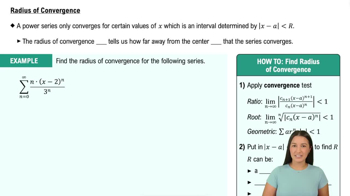
Radius of Convergence and Singularities

The radius of convergence of a Taylor series is limited by the nearest singularity to the center point. Since csc(x) has singularities where sin(x) = 0, the distance from π/2 to these points affects the convergence. Identifying these singularities helps determine if the Taylor series is valid.
추천 영상:
07:36
Radius of Convergence