Ch. 11 - Power Series
Briggs - Calculus: Early Transcendentals 3rd Edition
Briggs3rd EditionCalculus: Early TranscendentalsISBN: 9780136847243당신이 사용하는 게 아니라요?교과서 변경
11장, 문제 11.1.76b

{Use of Tech} Small argument approximations Consider the following common approximations when x is near zero. 


b. Estimate f(0.2) and give a bound on the error in the approximation.


f(x) = sin ⁻¹ x ≈ x

검증된 단계별 안내
1
Identify the function and the approximation given: the function is \(f(x) = \sin^{-1}(x)\), and the approximation near zero is \(f(x) \approx x\).
To estimate \(f(0.2)\) using the approximation, substitute \(x = 0.2\) into the approximation: \(f(0.2) \approx 0.2\).
To find a bound on the error, recall that the error in a linear approximation can be estimated using the remainder term from Taylor's theorem. For \(\sin^{-1}(x)\) expanded at 0, the next term after \(x\) involves \(x^3\).
The second derivative of \(f(x) = \sin^{-1}(x)\) is \(f''(x) = \frac{x}{(1 - x^2)^{3/2}}\). Use this to find a bound on the error by evaluating or bounding \(|f''(c)|\) for some \(c\) between 0 and 0.2.
Use the Lagrange form of the remainder: the error \(R_2\) satisfies \(|R_2| \leq \frac{M}{3!} |x|^3\), where \(M\) is the maximum value of \(|f''(c)|\) on the interval \([0, 0.2]\). Calculate or estimate \(M\) and then compute the error bound.

비슷한 문제에 대한 검증된 영상 답변:

이 영상 해법은 위 문제에 도움이 된다고 튜터들이 추천한 것입니다.
영상 길이:
4m
도움이 되었나요?

주요 개념

질문에 올바르게 답하기 위해 반드시 이해해야 하는 핵심 개념들은 다음과 같습니다.

Small Angle Approximations

Small angle approximations simplify functions like sin⁻¹(x) near zero by approximating them with simpler expressions, such as sin⁻¹(x) ≈ x. This is valid because the function and its approximation have the same value and slope at zero, making calculations easier for small x values.
추천 영상:
가이드 코스
04:57
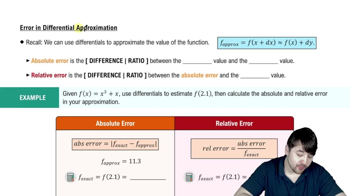
Determining Error and Relative Error

Error Bound Using Taylor's Remainder Theorem

Taylor's Remainder Theorem provides a way to estimate the error when approximating a function by a polynomial. It bounds the difference between the actual function value and the approximation using the next derivative term, ensuring the approximation's accuracy is quantifiable.
추천 영상:
08:42
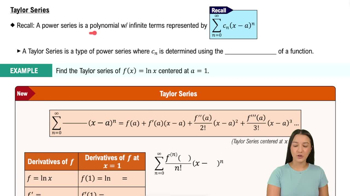
Taylor Series

Inverse Sine Function Properties

The inverse sine function, sin⁻¹(x), is continuous and differentiable near zero, with its derivative at zero equal to 1. Understanding these properties helps justify the linear approximation and calculate error bounds based on higher derivatives.
추천 영상:
4:03
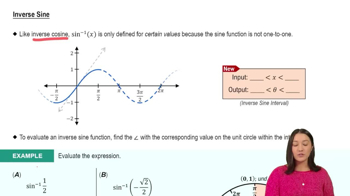
Inverse Sine