
Ch. 11 - Power Series
Briggs - Calculus: Early Transcendentals 3rd Edition
Briggs3rd EditionCalculus: Early TranscendentalsISBN: 9780136847243당신이 사용하는 게 아니라요?교과서 변경
11장, 문제 11.2.73

Exponential function In Section 11.3, we show that the power series for the exponential function centered at 0 is


eˣ = ∑ₖ₌₀∞ (xᵏ)/k!, for −∞ < x < ∞


Use the methods of this section to find the power series centered at 0 for the following functions. Give the interval of convergence for the resulting series.


f(x) = e⁻³ˣ

검증된 단계별 안내
1
Recall the power series expansion for the exponential function centered at 0: \[e^{x} = \sum_{k=0}^{\infty} \frac{x^{k}}{k!}\] which converges for all real numbers \[x\] (i.e., the interval of convergence is \[(-\infty, \infty)\]).
To find the power series for \[f(x) = e^{-3x}\], substitute \[-3x\] in place of \[x\] in the original series. This gives: \[e^{-3x} = \sum_{k=0}^{\infty} \frac{(-3x)^{k}}{k!}\].
Rewrite the terms inside the summation to separate powers of \[x\] and constants: \[e^{-3x} = \sum_{k=0}^{\infty} \frac{(-3)^{k} x^{k}}{k!}\].
Since the original exponential series converges for all real numbers, replacing \[x\] by \[-3x\] does not change the radius of convergence. Therefore, the interval of convergence remains \[(-\infty, \infty)\].
Summarize the power series for \[f(x)\] as \[f(x) = \sum_{k=0}^{\infty} \frac{(-3)^{k}}{k!} x^{k}\] with interval of convergence \[(-\infty, \infty)\].

비슷한 문제에 대한 검증된 영상 답변:

이 영상 해법은 위 문제에 도움이 된다고 튜터들이 추천한 것입니다.
영상 길이:
2m
도움이 되었나요?

주요 개념

질문에 올바르게 답하기 위해 반드시 이해해야 하는 핵심 개념들은 다음과 같습니다.

Power Series Representation of Functions

A power series expresses a function as an infinite sum of terms involving powers of the variable, typically centered at a point (here, 0). For example, the exponential function eˣ can be written as ∑ₖ₌₀∞ (xᵏ)/k!. Understanding this allows us to represent more complex functions by manipulating known series.
추천 영상:
07:32
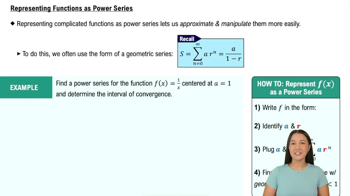
Representing Functions as Power Series

Substitution in Power Series

To find the power series of a function like f(x) = e⁻³ˣ, we substitute the inner expression (−3x) into the known series for eˣ. This means replacing x by −3x in the series, resulting in ∑ₖ₌₀∞ ((−3x)ᵏ)/k!. This technique helps generate new series from existing ones.
추천 영상:
05:58
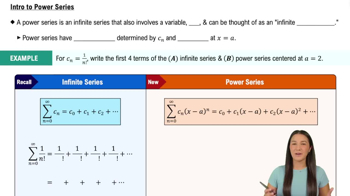
Intro to Power Series

Interval of Convergence

The interval of convergence is the set of x-values for which the power series converges to the function. For the exponential series, the interval is all real numbers (−∞, ∞). After substitution, it is important to verify if the interval changes, ensuring the series accurately represents the function within that domain.
추천 영상:
08:44
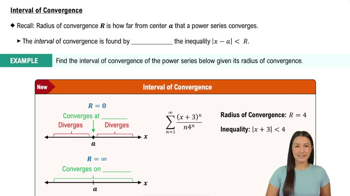
Interval of Convergence
관련 실천
교과서 질문

{Use of Tech} Newton's derivation of the sine and arcsine series Newton discovered the binomial series and then used it ingeniously to obtain many more results. Here is a case in point.

a. Referring to the figure, show that x = sin s or s = sin ⁻¹ x.

b. The area of a circular sector of radius r subtended by an angle θ is 1/2r²θ. Show that the area of the circular sector APE is s/2, which implies that

s = 2 ∫₀ˣ √(1 − t²) dt − x √(1 −x²)

c. Use the binomial series for f(x) = √(1 − x²) to obtain the first few terms of the Taylor series for s=sin ⁻¹ x.

d. Newton next inverted the series in part (c) to obtain the Taylor series for x=sin s. He did this by assuming sin s = ∑ aₖ sᵏ and solving x = sin(sin ⁻¹ x) for the coefficients aₖ. Find the first few terms of the Taylor series for sin s using this idea (a computer algebra system might be helpful as well).

124
views
교과서 질문

{Use of Tech} Maximum error Use the remainder term to find a bound on the error in the following approximations on the given interval. Error bounds are not unique.


tan x ≈ x on [−π/6, π/6]

89
views
교과서 질문

Radius and interval of convergence Determine the radius and interval of convergence of the following power series.


∑ₖ₌₁∞ (3x + 2)ᵏ/k

50
views
교과서 질문

Working with binomial series Use properties of power series, substitution, and factoring to find the first four nonzero terms of the Maclaurin series for the following functions. Use the Maclaurin series


(1 + x)⁻² = 1 − 2x + 3x² − 4x³ + ⋯, for −1 < x < 1.


(1 + 4x)⁻²

59
views
교과서 질문

Inverse sine Given the power series

1/√(1 − x²) = 1 + (1/2)x² + (1 ⋅ 3)/(2 ⋅ 4) x⁴ + (1 ⋅ 3 ⋅ 5)/(2 ⋅ 4 ⋅ 6) x⁶ +⋯

for −1<x<1, find the power series for f(x) = sin ⁻¹ x centered at 0.

65
views
교과서 질문

Limits Evaluate the following limits using Taylor series.

lim ₓ→₁ (x 1)/(ln x)

95
views