
Ch. 11 - Power Series
Briggs - Calculus: Early Transcendentals 3rd Edition
Briggs3rd EditionCalculus: Early TranscendentalsISBN: 9780136847243당신이 사용하는 게 아니라요?교과서 변경
11장, 문제 11.3.57

Working with binomial series Use properties of power series, substitution, and factoring to find the first four nonzero terms of the Maclaurin series for the following functions. Use the Maclaurin series


(1 + x)⁻² = 1 − 2x + 3x² − 4x³ + ⋯, for −1 < x < 1.


(1 + 4x)⁻²

검증된 단계별 안내
1
Recall the given Maclaurin series for the function \((1 + x)^{-2}\): \[ (1 + x)^{-2} = 1 - 2x + 3x^{2} - 4x^{3} + \cdots \]
To find the Maclaurin series for \((1 + 4x)^{-2}\), use substitution by replacing \(x\) with \$4x$ in the original series. This gives: \[ (1 + 4x)^{-2} = 1 - 2(4x) + 3(4x)^{2} - 4(4x)^{3} + \cdots \]
Simplify each term by calculating the powers and coefficients: - The linear term: \(-2 \times 4x = -8x\) - The quadratic term: \(3 \times (4x)^2 = 3 \times 16x^2 = 48x^2\) - The cubic term: \(-4 \times (4x)^3 = -4 \times 64x^3 = -256x^3\)
Write out the first four nonzero terms explicitly: \[ (1 + 4x)^{-2} = 1 - 8x + 48x^{2} - 256x^{3} + \cdots \]
Confirm the interval of convergence remains valid by considering the substitution: since the original series converges for \(|x| < 1\), the new series converges for \(|4x| < 1\), or equivalently \(|x| < \frac{1}{4}\).

비슷한 문제에 대한 검증된 영상 답변:

이 영상 해법은 위 문제에 도움이 된다고 튜터들이 추천한 것입니다.
영상 길이:
1m
도움이 되었나요?

주요 개념

질문에 올바르게 답하기 위해 반드시 이해해야 하는 핵심 개념들은 다음과 같습니다.

Maclaurin Series

A Maclaurin series is a special case of the Taylor series expanded at x = 0. It represents a function as an infinite sum of terms involving powers of x and derivatives evaluated at zero. Understanding this allows approximation of functions near zero using polynomials.
추천 영상:
08:26
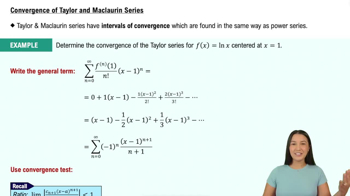
Convergence of Taylor & Maclaurin Series

Binomial Series Expansion

The binomial series generalizes the binomial theorem to any real exponent, expressing (1 + x)^n as an infinite power series. For negative integer exponents, it produces alternating terms with coefficients derived from binomial coefficients, useful for expanding functions like (1 + x)^-2.
추천 영상:
가이드 코스
06:00
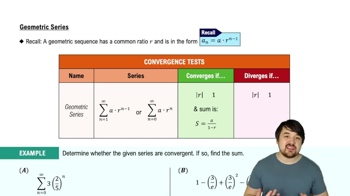
Geometric Series

Substitution and Factoring in Power Series

Substitution involves replacing x with another expression inside a known power series to find expansions of related functions. Factoring helps simplify expressions before expansion. Together, they enable finding series for functions like (1 + 4x)^-2 by adapting the known series for (1 + x)^-2.
추천 영상:
05:58
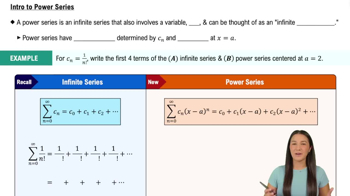
Intro to Power Series
관련 실천
교과서 질문

L'Hôpital's Rule by Taylor series Suppose f and g have Taylor series about the point a.

a. If f(a) = g(a) = 0 and g′(a) ≠ 0, evaluate lim ₓ→ₐ f(x)/g(x) by expanding f and g in their Taylor series. Show that the result is consistent withl’Hôpital’s Rule.

b. If f(a) = g(a) =f′(a) = g′(a) = 0 and g′′(a) ≠ 0, evaluate lim ₓ→ₐ f(x)/g(x) by expanding f and g in their Taylor series. Show that the result is consistent with two applications of 1'Hôpital's Rule.

55
views
교과서 질문

Exponential function In Section 11.3, we show that the power series for the exponential function centered at 0 is


eˣ = ∑ₖ₌₀∞ (xᵏ)/k!, for −∞ < x < ∞


Use the methods of this section to find the power series centered at 0 for the following functions. Give the interval of convergence for the resulting series.


f(x) = e⁻³ˣ

86
views
교과서 질문

Radius and interval of convergence Determine the radius and interval of convergence of the following power series.


∑ₖ₌₁∞ (3x + 2)ᵏ/k

50
views
교과서 질문

{Use of Tech} Approximating powers Compute the coefficients for the Taylor series for the following functions about the given point a, and then use the first four terms of the series to approximate the given number.

f(x) =∛x with a=64; approximate ∛60.

55
views
교과서 질문

Manipulating Taylor series Use the Taylor series in Table 11.5 to find the first four nonzero terms of the Taylor series for the following functions centered at 0.


sinh x²

79
views
교과서 질문

Differential equations


a. Find a power series for the solution of the following differential equations, subject to the given initial condition

b. Identify the function represented by the power series.


y′(t) − y = 0, y(0) = 2

69
views