Ch. 11 - Power Series
Briggs - Calculus: Early Transcendentals 3rd Edition
Briggs3rd EditionCalculus: Early TranscendentalsISBN: 9780136847243당신이 사용하는 게 아니라요?교과서 변경
11장, 문제 11.4.8

Limits Evaluate the following limits using Taylor series.
lim ₓ→₀ (tan ⁻¹ x − x)/x³"

검증된 단계별 안내
1
Recognize that the problem asks to evaluate the limit \( \lim_{x \to 0} \frac{\tan^{-1} x - x}{x^3} \) using Taylor series expansions.
Recall the Taylor series expansion of \( \tan^{-1} x \) around \( x = 0 \): \[ \tan^{-1} x = x - \frac{x^3}{3} + \frac{x^5}{5} - \cdots \]
Substitute the Taylor series expansion into the numerator: \[ \tan^{-1} x - x = \left(x - \frac{x^3}{3} + \cdots \right) - x = - \frac{x^3}{3} + \cdots \]
Rewrite the original limit expression using this substitution: \[ \lim_{x \to 0} \frac{\tan^{-1} x - x}{x^3} = \lim_{x \to 0} \frac{- \frac{x^3}{3} + \cdots}{x^3} \]
Simplify the fraction by dividing each term by \( x^3 \), then evaluate the limit by letting \( x \to 0 \), which will eliminate higher order terms, leaving the coefficient of the leading term.

비슷한 문제에 대한 검증된 영상 답변:

이 영상 해법은 위 문제에 도움이 된다고 튜터들이 추천한 것입니다.
영상 길이:
2m
도움이 되었나요?

주요 개념

질문에 올바르게 답하기 위해 반드시 이해해야 하는 핵심 개념들은 다음과 같습니다.

Taylor Series Expansion

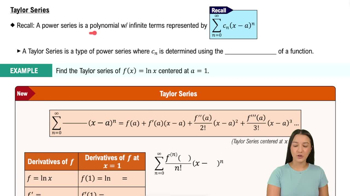
A Taylor series represents a function as an infinite sum of terms calculated from the function's derivatives at a single point. It approximates functions near that point, allowing complex expressions to be simplified into polynomials. For limits, Taylor expansions help identify dominant terms and simplify evaluation.
추천 영상:
08:42
Taylor Series

Inverse Tangent Function (arctan) Properties

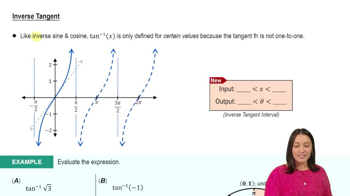
The inverse tangent function, arctan(x), is smooth and differentiable around zero, with a known Taylor series expansion. Understanding its series helps express arctan(x) as x minus higher-order terms, which is essential for evaluating limits involving arctan(x) near zero.
추천 영상:
3:17
Inverse Tangent

Limit Evaluation Using Series Expansion

When direct substitution in a limit leads to an indeterminate form, expanding functions into their Taylor series can reveal the behavior of the numerator and denominator. By comparing the lowest-order nonzero terms, one can compute the limit accurately without complex algebraic manipulation.
추천 영상:
가이드 코스
06:45
Intro to Series: Partial Sums
관련 실천
교과서 질문

Functions to power series Find power series representations centered at 0 for the following functions using known power series. Give the interval of convergence for the resulting series.

f(x) = 2x/(1 + x²)²

78
views

교과서 질문

Series to functions Find the function represented by the following series, and find the interval of convergence of the series. (Not all these series are power series.)


 ∑ₖ₌₀∞ e⁻ᵏˣ

40
views
교과서 질문

Series to functions Find the function represented by the following series, and find the interval of convergence of the series. (Not all these series are power series.)


∑ₖ₌₀∞(√x − 2)ᵏ

74
views
교과서 질문

Use of Tech Linear and quadratic approximation


a. Find the linear approximating polynomial for the following functions centered at the given point a.


b. Find the quadratic approximating polynomial for the following functions centered at a.


c Use the polynomials obtained in parts (a) and (b) to approximate the given quantity.


f(x)=e⁻²ˣ, a=0; approximate e⁻⁰ᐧ².

56
views
교과서 질문

Exponential function In Section 11.3, we show that the power series for the exponential function centered at 0 is


eˣ = ∑ₖ₌₀∞ (xᵏ)/k!, for −∞ < x < ∞


Use the methods of this section to find the power series centered at 0 for the following functions. Give the interval of convergence for the resulting series.


f(x) = x²eˣ

81
views
교과서 질문

Radius of convergence Find the radius of convergence for the following power series.

∑ₖ₌₁∞ (1−cos (1/2ᵏ)) xᵏ

70
views