Ch. 11 - Power Series
Briggs - Calculus: Early Transcendentals 3rd Edition
Briggs3rd EditionCalculus: Early TranscendentalsISBN: 9780136847243당신이 사용하는 게 아니라요?교과서 변경
11장, 문제 11.4.76b

Probability: sudden−death playoff Teams A and B go into suddendeath overtime after playing to a tie. The teams alternate possession of the ball, and the first team to score wins. Assume each team has a 1/6 chance of scoring when it has the ball, and Team A has the ball first.


b. The expected number of rounds (possessions by either team) required for the overtime to end is (1/6) ∑ₖ₌₁∞ k(5/6)ᵏ⁻¹. Evaluate this series.

검증된 단계별 안내
1
Recognize that the series given is of the form \(\sum_{k=1}^\infty k r^{k-1}\) where \(r = \frac{5}{6}\). This is a standard series related to the expected value of a geometric distribution.
Recall the formula for the sum of the series \(\sum_{k=1}^\infty k r^{k-1} = \frac{1}{(1-r)^2}\) for \(|r| < 1\).
Substitute \(r = \frac{5}{6}\) into the formula to get \(\sum_{k=1}^\infty k \left(\frac{5}{6}\right)^{k-1} = \frac{1}{\left(1 - \frac{5}{6}\right)^2}\).
Simplify the denominator: \(1 - \frac{5}{6} = \frac{1}{6}\), so the sum becomes \(\frac{1}{\left(\frac{1}{6}\right)^2}\).
Calculate the final expression for the sum as \(\frac{1}{\left(\frac{1}{6}\right)^2} = 36\), then multiply by the outside factor \(\frac{1}{6}\) to find the expected number of rounds.

비슷한 문제에 대한 검증된 영상 답변:

이 영상 해법은 위 문제에 도움이 된다고 튜터들이 추천한 것입니다.
영상 길이:
4m
도움이 되었나요?

주요 개념

질문에 올바르게 답하기 위해 반드시 이해해야 하는 핵심 개념들은 다음과 같습니다.

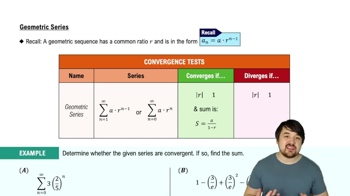
Geometric Series

A geometric series is a sum of terms where each term is a constant multiple (common ratio) of the previous one. It converges if the absolute value of the ratio is less than 1, and its sum can be found using a formula. Understanding geometric series helps evaluate infinite sums like ∑ k r^(k-1).
추천 영상:
가이드 코스
06:00
Geometric Series

Expected Value of a Discrete Random Variable

The expected value is the weighted average of all possible outcomes, where weights are their probabilities. For a discrete variable representing the number of trials until success, the expected value can be expressed as a sum involving k and the probability of success/failure, often linked to geometric distributions.
추천 영상:
가이드 코스
06:37
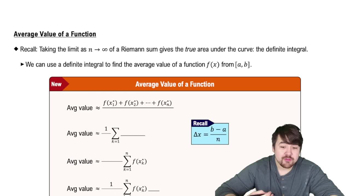
Average Value of a Function

Sum of k times r^(k-1) for |r|<1

The series ∑ k r^(k-1) for |r|<1 has a closed-form sum equal to 1/(1-r)^2. This formula is derived by differentiating the sum of a geometric series and is essential for evaluating expected values in problems involving geometric probabilities.
추천 영상:
가이드 코스
10:22
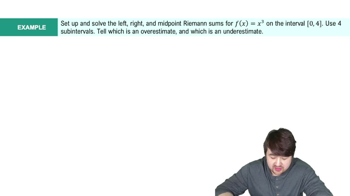
Left, Right, & Midpoint Riemann Sums Example 1