
Ch. 11 - Power Series
Briggs - Calculus: Early Transcendentals 3rd Edition
Briggs3rd EditionCalculus: Early TranscendentalsISBN: 9780136847243당신이 사용하는 게 아니라요?교과서 변경
11장, 문제 11.3.25a

Taylor series and interval of convergence


a. Use the definition of a Taylor/Maclaurin series to find the first four nonzero terms of the Taylor series for the given function centered at a.


f(x) = ln (x − 2), a = 3

검증된 단계별 안내
1
Recall the definition of the Taylor series of a function \(f(x)\) centered at \(a\): \[f(x) = \sum_{n=0}^{\infty} \frac{f^{(n)}(a)}{n!} (x - a)^n,\] where \(f^{(n)}(a)\) is the \(n\)-th derivative of \(f\) evaluated at \(x = a\).
Identify the function and center: here, \(f(x) = \ln(x - 2)\) and the center is \(a = 3\). We will find derivatives of \(f\) at \(x=3\).
Compute the first derivative: \[f'(x) = \frac{1}{x - 2}.\] Evaluate at \(x=3\): \[f'(3) = \frac{1}{3 - 2} = 1.\]
Find higher order derivatives by differentiating repeatedly: - Second derivative: \[f''(x) = -\frac{1}{(x - 2)^2}\] Evaluate at \(x=3\): \[f''(3) = -1.\] - Third derivative: \[f^{(3)}(x) = \frac{2}{(x - 2)^3}\] Evaluate at \(x=3\): \[f^{(3)}(3) = 2.\] - Fourth derivative: \[f^{(4)}(x) = -\frac{6}{(x - 2)^4}\] Evaluate at \(x=3\): \[f^{(4)}(3) = -6.\]
Write the first four nonzero terms of the Taylor series using the formula: \[f(x) \approx f(3) + f'(3)(x - 3) + \frac{f''(3)}{2!}(x - 3)^2 + \frac{f^{(3)}(3)}{3!}(x - 3)^3 + \frac{f^{(4)}(3)}{4!}(x - 3)^4.\] Substitute the values found for \(f(3)\) and the derivatives to express the series up to the fourth term.

비슷한 문제에 대한 검증된 영상 답변:

이 영상 해법은 위 문제에 도움이 된다고 튜터들이 추천한 것입니다.
영상 길이:
7m

주요 개념

질문에 올바르게 답하기 위해 반드시 이해해야 하는 핵심 개념들은 다음과 같습니다.

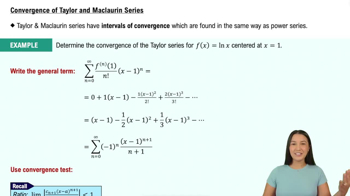
Taylor and Maclaurin Series

A Taylor series represents a function as an infinite sum of terms calculated from the derivatives of the function at a single point a. When a = 0, it is called a Maclaurin series. Each term involves the nth derivative evaluated at a, multiplied by (x - a)^n and divided by n!. This series approximates the function near the point a.
추천 영상:
08:26
Convergence of Taylor & Maclaurin Series

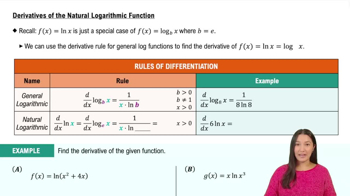
Derivatives of Logarithmic Functions

To find the Taylor series of f(x) = ln(x - 2), you need to compute successive derivatives of the logarithmic function. The first derivative is 1/(x - 2), and higher derivatives involve powers of (x - 2) in the denominator with alternating signs. Understanding these derivatives is essential to form the terms of the series.
추천 영상:
05:18
Derivative of the Natural Logarithmic Function

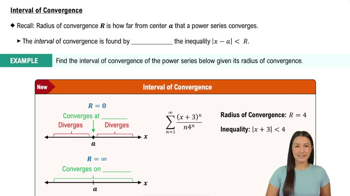
Interval of Convergence

The interval of convergence is the range of x-values for which the Taylor series converges to the function. For ln(x - 2) centered at a = 3, the series converges where |x - 3| is less than the distance to the nearest singularity (x = 2). Determining this interval ensures the series accurately represents the function.
추천 영상:
08:44
Interval of Convergence