Ch. 11 - Power Series
Briggs - Calculus: Early Transcendentals 3rd Edition
Briggs3rd EditionCalculus: Early TranscendentalsISBN: 9780136847243당신이 사용하는 게 아니라요?교과서 변경
11장, 문제 11.2.21

Radius and interval of convergence Determine the radius and interval of convergence of the following power series.


−x²/1 + x⁴/2! −x⁶/3! + x⁸/4! − ⋯

검증된 단계별 안내
1
First, rewrite the given power series in a general term form. Notice the pattern of powers and factorials: the nth term looks like \((-1)^n \frac{x^{2(n+1)}}{(n+1)!}\), starting from \(n=0\).
Identify the general term \(a_n = (-1)^n \frac{x^{2(n+1)}}{(n+1)!}\). To analyze convergence, it is often easier to express the series as \(\sum_{n=0}^\infty (-1)^n \frac{x^{2(n+1)}}{(n+1)!}\).
Apply the Ratio Test to find the radius of convergence. Compute the limit \(L = \lim_{n \to \infty} \left| \frac{a_{n+1}}{a_n} \right|\) where \(a_n = (-1)^n \frac{x^{2(n+1)}}{(n+1)!}\).
Simplify the ratio inside the limit: \(\left| \frac{a_{n+1}}{a_n} \right| = \left| \frac{x^{2(n+2)}}{(n+2)!} \cdot \frac{(n+1)!}{x^{2(n+1)}} \right| = \left| \frac{x^2}{n+2} \right|\).
Evaluate the limit as \(n \to \infty\): \(L = \lim_{n \to \infty} \left| \frac{x^2}{n+2} \right| = 0\) for all real \(x\). Since \(L=0 < 1\) for all \(x\), the radius of convergence is infinite, meaning the series converges for all real \(x\). Thus, the interval of convergence is \((-\infty, \infty)\).

비슷한 문제에 대한 검증된 영상 답변:

이 영상 해법은 위 문제에 도움이 된다고 튜터들이 추천한 것입니다.
영상 길이:
4m

주요 개념

질문에 올바르게 답하기 위해 반드시 이해해야 하는 핵심 개념들은 다음과 같습니다.

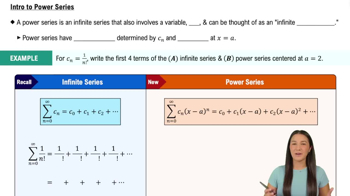
Power Series

A power series is an infinite sum of terms in the form a_n(x - c)^n, where a_n are coefficients and c is the center. Understanding the structure of power series helps analyze their convergence behavior depending on the value of x.
추천 영상:
05:58
Intro to Power Series

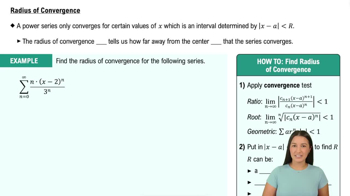
Radius of Convergence

The radius of convergence is the distance from the center within which a power series converges absolutely. It can be found using tests like the Ratio Test or Root Test, indicating the interval where the series represents a valid function.
추천 영상:
07:36
Radius of Convergence

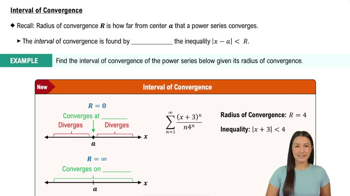
Interval of Convergence

The interval of convergence is the set of all x-values for which the power series converges. It includes the radius of convergence and requires checking endpoints separately to determine if the series converges or diverges there.
추천 영상:
08:44
Interval of Convergence
관련 실천
교과서 질문

Remainders Find the remainder in the Taylor series centered at the point a for the following functions. Then show that lim ₙ→∞ Rₙ(x)=0, for all x in the interval of convergence.


f(x) = e⁻ˣ, a = 0

66
views

교과서 질문

Radius and interval of convergence Determine the radius and interval of convergence of the following power series.


∑ₖ₌₀∞ (2x)ᵏ/k!

75
views
교과서 질문

Probability: tossing for a head The expected (average) number of tosses of a fair coin required to obtain the first head is ∑ₖ₌₁∞ k(1/2)ᵏ. Evaluate this series and determine the expected number of tosses. (Hint: Differentiate a geometric series.) 

41
views
교과서 질문

Any method


a. Use any analytical method to find the first four nonzero terms of the Taylor series centered at 0 for the following functions. You do not need to use the definition of the Taylor series coefficients.


b. Determine the radius of convergence of the series.


f(x) = (1 + x²)⁻²/³

69
views
교과서 질문

Manipulating Taylor series Use the Taylor series in Table 11.5 to find the first four nonzero terms of the Taylor series for the following functions centered at 0.


ln (1 + x²)

78
views
교과서 질문

Use of Tech Linear and quadratic approximation


a. Find the linear approximating polynomial for the following functions centered at the given point a.


b. Find the quadratic approximating polynomial for the following functions centered at a.


c Use the polynomials obtained in parts (a) and (b) to approximate the given quantity.


f(x) = cos x, a = π/4; approximate cos (0.24π)

72
views