Ch. 11 - Power Series
Briggs - Calculus: Early Transcendentals 3rd Edition
Briggs3rd EditionCalculus: Early TranscendentalsISBN: 9780136847243당신이 사용하는 게 아니라요?교과서 변경
11장, 문제 11.4.75

Probability: tossing for a head The expected (average) number of tosses of a fair coin required to obtain the first head is ∑ₖ₌₁∞ k(1/2)ᵏ. Evaluate this series and determine the expected number of tosses. (Hint: Differentiate a geometric series.) 

검증된 단계별 안내
1
Recognize that the expected number of tosses to get the first head in a fair coin toss is given by the infinite series \(\sum_{k=1}^{\infty} k \left(\frac{1}{2}\right)^k\). This is a weighted sum where \(k\) represents the toss number and \(\left(\frac{1}{2}\right)^k\) is the probability of getting the first head on the \(k\)-th toss.
Recall the geometric series formula: for \(|x| < 1\), \(\sum_{k=0}^{\infty} x^k = \frac{1}{1-x}\). To involve the factor \(k\) in the sum, differentiate both sides with respect to \(x\) to bring down the \(k\) term.
Differentiate the geometric series term-by-term: \(\frac{d}{dx} \sum_{k=0}^{\infty} x^k = \sum_{k=1}^{\infty} k x^{k-1} = \frac{d}{dx} \left( \frac{1}{1-x} \right) = \frac{1}{(1-x)^2}\). Multiply both sides by \(x\) to get \(\sum_{k=1}^{\infty} k x^k = \frac{x}{(1-x)^2}\).
Substitute \(x = \frac{1}{2}\) into the differentiated series formula to evaluate the sum: \(\sum_{k=1}^{\infty} k \left(\frac{1}{2}\right)^k = \frac{\frac{1}{2}}{\left(1 - \frac{1}{2}\right)^2}\).
Simplify the expression to find the expected number of tosses required to get the first head. This value represents the average number of tosses needed in the long run.

비슷한 문제에 대한 검증된 영상 답변:

이 영상 해법은 위 문제에 도움이 된다고 튜터들이 추천한 것입니다.
영상 길이:
4m

주요 개념

질문에 올바르게 답하기 위해 반드시 이해해야 하는 핵심 개념들은 다음과 같습니다.

Expected Value in Probability

The expected value is the average outcome of a random experiment over many trials. For discrete random variables, it is calculated as the sum of each possible value multiplied by its probability. In this problem, it represents the average number of coin tosses needed to get the first head.
추천 영상:
가이드 코스
06:37
Average Value of a Function

Geometric Series and Its Sum

A geometric series is a sum of terms where each term is a constant ratio times the previous term. The sum of an infinite geometric series with ratio |r| < 1 is S = a / (1 - r), where a is the first term. Recognizing the series in the problem as geometric helps in evaluating it.
추천 영상:
가이드 코스
06:00
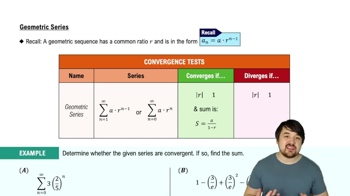
Geometric Series

Differentiation of a Geometric Series

Differentiating the sum formula of a geometric series with respect to its ratio allows us to find sums involving terms multiplied by their indices, like ∑ k r^k. This technique is key to evaluating the expected value series, which includes the term k(1/2)^k.
추천 영상:
가이드 코스
06:00
Geometric Series
관련 실천
교과서 질문

Radius and interval of convergence Determine the radius and interval of convergence of the following power series.


∑ₖ₌₀∞ (2x)ᵏ

34
views

교과서 질문

Suppose you know the Maclaurin series for f and that it converges to f(x) for |x|<1. How do you find the Maclaurin series for f(x²) and where does it converge?

67
views
교과서 질문

{Use of Tech} A different kind of approximation When approximating a function f using a Taylor polynomial, we use information about f and its derivative at one point. An alternative approach (called interpolation) uses information about f at several different points. Suppose we wish to approximate f(x)=sin x on the interval [0, π].


a. Write the (quadratic) Taylor polynomial p₂ for f centered at π/2.


b. Now consider a quadratic interpolating polynomial q(x) = ax² + bx + c. The coefficients a, b, and c are chosen such that the following conditions are satisfied:

q(0) = f(0), q(π/2) = f(π/2), and q(π) = f(π)


Show that q(x) = −(4/π²)x² + (4/π)x.


c. Graph f, p₂, and q on [0, π].


d. Find the error in approximating f(x) = sin x at the points π/4, π/2, 3π/4, and π using p₂ and q.


e. Which function, p₂ or q, is a better approximation to f on [0, π]? Explain.

52
views
교과서 질문

Any method


a. Use any analytical method to find the first four nonzero terms of the Taylor series centered at 0 for the following functions. You do not need to use the definition of the Taylor series coefficients.


b. Determine the radius of convergence of the series.


f(x) = (1 + x²)⁻²/³

69
views
교과서 질문

Manipulating Taylor series Use the Taylor series in Table 11.5 to find the first four nonzero terms of the Taylor series for the following functions centered at 0.


ln (1 + x²)

78
views
교과서 질문

Radius and interval of convergence Determine the radius and interval of convergence of the following power series.


−x²/1 + x⁴/2! −x⁶/3! + x⁸/4! − ⋯

65
views