Ch. 11 - Power Series
Briggs - Calculus: Early Transcendentals 3rd Edition
Briggs3rd EditionCalculus: Early TranscendentalsISBN: 9780136847243당신이 사용하는 게 아니라요?교과서 변경
11장, 문제 11.1.88

{Use of Tech} A different kind of approximation When approximating a function f using a Taylor polynomial, we use information about f and its derivative at one point. An alternative approach (called interpolation) uses information about f at several different points. Suppose we wish to approximate f(x)=sin x on the interval [0, π].


a. Write the (quadratic) Taylor polynomial p₂ for f centered at π/2.


b. Now consider a quadratic interpolating polynomial q(x) = ax² + bx + c. The coefficients a, b, and c are chosen such that the following conditions are satisfied:
q(0) = f(0), q(π/2) = f(π/2), and q(π) = f(π)


Show that q(x) = −(4/π²)x² + (4/π)x.


c. Graph f, p₂, and q on [0, π].


d. Find the error in approximating f(x) = sin x at the points π/4, π/2, 3π/4, and π using p₂ and q.


e. Which function, p₂ or q, is a better approximation to f on [0, π]? Explain.

검증된 단계별 안내
1
a. To write the quadratic Taylor polynomial \(p_2\) for \(f(x) = \sin x\) centered at \(x = \frac{\pi}{2}\), start by computing the function value and the first two derivatives at \(x = \frac{\pi}{2}\). Recall the Taylor polynomial formula up to degree 2: \[p_2(x) = f\left(\frac{\pi}{2}\right) + f'\left(\frac{\pi}{2}\right)(x - \frac{\pi}{2}) + \frac{f''\left(\frac{\pi}{2}\right)}{2}(x - \frac{\pi}{2})^2\] Calculate \(f\left(\frac{\pi}{2}\right)\), \(f'\left(\frac{\pi}{2}\right)\), and \(f''\left(\frac{\pi}{2}\right)\) explicitly.
b. For the quadratic interpolating polynomial \(q(x) = ax^2 + bx + c\), use the given conditions: \[q(0) = f(0), \quad q\left(\frac{\pi}{2}\right) = f\left(\frac{\pi}{2}\right), \quad q(\pi) = f(\pi)\] Substitute these points into \(q(x)\) to form a system of three equations: \[c = f(0)\] \[a\left(\frac{\pi}{2}\right)^2 + b\left(\frac{\pi}{2}\right) + c = f\left(\frac{\pi}{2}\right)\] \[a\pi^2 + b\pi + c = f(\pi)\] Solve this system for \(a\), \(b\), and \(c\) to find the explicit form of \(q(x)\).
c. To graph \(f(x) = \sin x\), \(p_2(x)\), and \(q(x)\) on the interval \([0, \pi]\), plot each function using the expressions found in parts (a) and (b). This visual comparison helps to see how well each polynomial approximates \(\sin x\) over the interval.
d. To find the error at points \(x = \frac{\pi}{4}, \frac{\pi}{2}, \frac{3\pi}{4}, \pi\), compute the absolute difference between \(f(x)\) and each approximation: \[\text{Error for } p_2 = |f(x) - p_2(x)|\] \[\text{Error for } q = |f(x) - q(x)|\] Calculate these values for each specified \(x\) to quantify the accuracy of each polynomial at those points.
e. To determine which polynomial, \(p_2\) or \(q\), is a better approximation on \([0, \pi]\), compare the errors computed in part (d) across the points. Consider the nature of each approximation: \(p_2\) uses local derivative information at \(\frac{\pi}{2}\), while \(q\) uses interpolation at three points. Discuss which method yields smaller errors overall and why, based on the error behavior and the construction of the polynomials.

비슷한 문제에 대한 검증된 영상 답변:

이 영상 해법은 위 문제에 도움이 된다고 튜터들이 추천한 것입니다.
영상 길이:
2m
도움이 되었나요?

주요 개념

질문에 올바르게 답하기 위해 반드시 이해해야 하는 핵심 개념들은 다음과 같습니다.

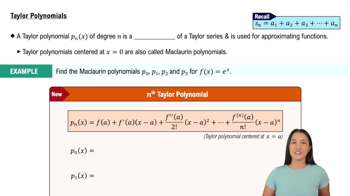
Taylor Polynomial Approximation

A Taylor polynomial approximates a function near a single point using the function's derivatives at that point. For a quadratic Taylor polynomial, the function, its first derivative, and second derivative at the center point determine the polynomial. This method captures local behavior but may not approximate well far from the center.
추천 영상:
07:00
Taylor Polynomials

Polynomial Interpolation

Polynomial interpolation constructs a polynomial that exactly matches the function's values at several distinct points. For quadratic interpolation, three points determine the coefficients of a second-degree polynomial. This approach uses global information and can provide a better fit over an interval than a Taylor polynomial centered at one point.
추천 영상:
07:00
Taylor Polynomials

Error Analysis in Approximation

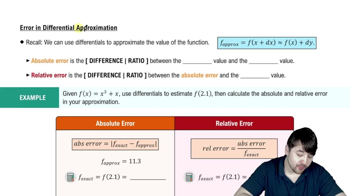
Error analysis compares the difference between the original function and its approximation at specific points. Evaluating errors at multiple points helps assess which approximation is more accurate over an interval. Understanding error behavior guides the choice between Taylor and interpolating polynomials.
추천 영상:
04:57
Determining Error and Relative Error
관련 실천
교과서 질문

Radius and interval of convergence Determine the radius and interval of convergence of the following power series.


∑ₖ₌₀∞ (2x)ᵏ

34
views

교과서 질문

Suppose you know the Maclaurin series for f and that it converges to f(x) for |x|<1. How do you find the Maclaurin series for f(x²) and where does it converge?

67
views
교과서 질문

{Use of Tech} Estimating errors Use the remainder to find a bound on the error in approximating the following quantities with the nth-order Taylor polynomial centered at 0. Estimates are not unique.


ln 1.04, n=3

65
views
교과서 질문

{Use of Tech} Approximating sin x Let f(x)=sin x, and let pₙ and qₙ be nth−order Taylor polynomials for f centered at 0 and π, respectively.

a. Find p₅ and q₅

b. Graph f, p₅, and q₅ on the interval [−π, 2π]. On what interval is p₅ a better approximation to f than q₅? On what interval is q₅ a better approximation to f than p₅?

c. Complete the following table showing the errors in the approximations given by p₅ and q₅ at selected points.

d. At which points in the table is p₅ a better approximation to f than q₅? At which points do p₅ and q₅ give equal approximations to f? Explain your observations.

41
views
교과서 질문

Probability: tossing for a head The expected (average) number of tosses of a fair coin required to obtain the first head is ∑ₖ₌₁∞ k(1/2)ᵏ. Evaluate this series and determine the expected number of tosses. (Hint: Differentiate a geometric series.) 

41
views
교과서 질문

{Use of Tech} Estimating errors Use the remainder to find a bound on the error in approximating the following quantities with the nth-order Taylor polynomial centered at 0. Estimates are not unique.


sin 0.3, n = 4

72
views