

Ch. 2 - Limits
Briggs - Calculus: Early Transcendentals 3rd Edition
Briggs3rd EditionCalculus: Early TranscendentalsISBN: 9780136847243당신이 사용하는 게 아니라요?교과서 변경
2장, 문제 2.5.61

Determine the end behavior of the following transcendental functions by analyzing appropriate limits. Then provide a simple sketch of the associated graph, showing asymptotes if they exist. 
f(x)=sinxf\(\left\)(x\(\right\))=\(\sin\) x

검증된 단계별 안내
1
Step 1: Understand the function f(x) = sin(x). The sine function is periodic with a period of 2π, meaning it repeats its values every 2π units along the x-axis.
Step 2: Analyze the range of the sine function. The sine function oscillates between -1 and 1 for all x, so its range is [-1, 1].
Step 3: Determine the end behavior by considering the limits as x approaches positive and negative infinity. Since sin(x) is periodic and bounded, it does not approach a specific value as x approaches infinity or negative infinity.
Step 4: Identify any asymptotes. The sine function does not have any vertical or horizontal asymptotes because it is bounded and periodic.
Step 5: Sketch the graph of f(x) = sin(x). Draw a wave-like pattern oscillating between -1 and 1, repeating every 2π along the x-axis, with no asymptotes.

비슷한 문제에 대한 검증된 영상 답변:

이 영상 해법은 위 문제에 도움이 된다고 튜터들이 추천한 것입니다.
영상 길이:
12m
도움이 되었나요?

주요 개념

질문에 올바르게 답하기 위해 반드시 이해해야 하는 핵심 개념들은 다음과 같습니다.

End Behavior of Functions

End behavior refers to the behavior of a function as the input values approach positive or negative infinity. Understanding end behavior is crucial for analyzing limits and determining how a function behaves at its extremes. For example, knowing whether a function approaches a specific value, diverges, or oscillates helps in sketching its graph accurately.
추천 영상:
5:46
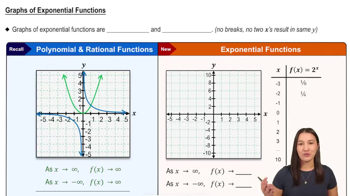
Graphs of Exponential Functions

Limits

Limits are fundamental in calculus, representing the value that a function approaches as the input approaches a certain point. They are essential for understanding continuity, derivatives, and integrals. In the context of transcendental functions like sine, limits help determine the function's behavior at infinity, which is vital for analyzing end behavior.
추천 영상:
05:50
One-Sided Limits

Asymptotes

Asymptotes are lines that a graph approaches but never touches, indicating the behavior of a function as it extends towards infinity. They can be vertical, horizontal, or oblique, depending on the function's characteristics. Identifying asymptotes is important for sketching graphs accurately, especially for functions that exhibit unbounded behavior or oscillation.
추천 영상:
가이드 코스
5:37
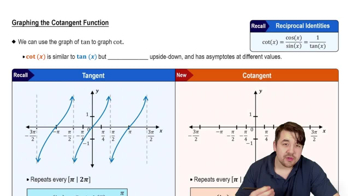
Introduction to Cotangent Graph
관련 실천
교과서 질문

If a function f represents a system that varies in time, the existence of lim limtf(t){\(\displaystyle\[\lim\)_{t\(\rightarrow\]\infty\)}{f(t)}} means that the system reaches a steady state (or equilibrium). For the following systems, determine whether a steady state exists and give the steady-state value.


The population of a culture of tumor cells is given by p(t)=3500tt+1p\(\left\)(t\(\right\))=\(\frac{3500t}{t+1}\).

373
views
교과서 질문

Evaluate each limit and justify your answer. 

lim x→2 (3 / 2x^5−4x^2−50)^4

349
views
교과서 질문

Use the definitions given in Exercise 57 to prove the following infinite limits.


lim x→1^+ 1 /1 − x=−∞

297
views
교과서 질문

Find all vertical asymptotes x=ax=a of the following functions. For each value of aa, determine limxa+f(x){\(\displaystyle\]\lim\)_{x\(\to\) a^{+}}}f\(\left\)(x\(\right\)), limxaf(x){\(\displaystyle\]\lim\)_{x\(\to\) a^{-}}}f\(\left\)(x\(\right\)), and limxaf(x){\(\displaystyle\]\lim\)_{x\(\to\) a}}f\(\left\)(x\(\right\)).

f(x)=x+1x34x2+4xf\(\left\)(x\(\right\))=\(\frac{x+1}{x^3-4x^2+4x}\)

347
views
교과서 질문

Use the precise definition of a limit to prove the following limits. Specify a relationship between ε and δ that guarantees the limit exists.

lim x→7 f(x)=9, where f(x)={3x−12 if x≤7

x+2 if x>7

365
views
교과서 질문

Use the precise definition of infinite limits to prove the following limits.


limx0(1x4sin(x))={\(\displaystyle\[\lim\)_{x\(\to\)0}}\(\left\)(\(\frac{1}{x^4}\)-\(\sin\]\left\)(x\(\right\))\(\right\))=\(\infty\)

322
views