Ch. 2 - Limits
Briggs - Calculus: Early Transcendentals 3rd Edition
Briggs3rd EditionCalculus: Early TranscendentalsISBN: 9780136847243당신이 사용하는 게 아니라요?교과서 변경
2장, 문제 2.5.66

If a function f represents a system that varies in time, the existence of lim limtf(t){\(\displaystyle\[\lim\)_{t\(\rightarrow\]\infty\)}{f(t)}} means that the system reaches a steady state (or equilibrium). For the following systems, determine whether a steady state exists and give the steady-state value.


The population of a culture of tumor cells is given by p(t)=3500tt+1p\(\left\)(t\(\right\))=\(\frac{3500t}{t+1}\).

검증된 단계별 안내
1
First, identify the function given: \( p(t) = \frac{3500t}{t+1} \). This function represents the population of tumor cells over time.
To determine if a steady state exists, we need to evaluate the limit of \( p(t) \) as \( t \) approaches infinity: \( \lim_{t \to \infty} \frac{3500t}{t+1} \).
Simplify the expression by dividing the numerator and the denominator by \( t \), the highest power of \( t \) in the denominator: \( \frac{3500t/t}{(t+1)/t} = \frac{3500}{1 + 1/t} \).
As \( t \to \infty \), the term \( 1/t \) approaches 0. Therefore, the expression simplifies to \( \frac{3500}{1 + 0} = 3500 \).
Conclude that the limit exists and the steady-state value of the population is 3500. This means the population of tumor cells approaches 3500 as time goes to infinity, indicating a steady state.

비슷한 문제에 대한 검증된 영상 답변:

이 영상 해법은 위 문제에 도움이 된다고 튜터들이 추천한 것입니다.
영상 길이:
2m
도움이 되었나요?

주요 개념

질문에 올바르게 답하기 위해 반드시 이해해야 하는 핵심 개념들은 다음과 같습니다.

Limit of a Function

The limit of a function describes the behavior of that function as the input approaches a certain value, which can be finite or infinite. In this context, the limit as t approaches infinity indicates how the function behaves as time progresses indefinitely. Understanding limits is crucial for analyzing the long-term behavior of dynamic systems, such as populations or physical processes.
추천 영상:
06:11
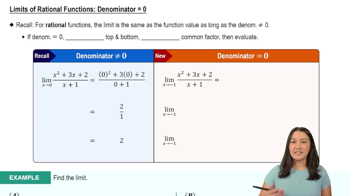
Limits of Rational Functions: Denominator = 0

Steady State (Equilibrium)

A steady state, or equilibrium, occurs when a system's variables remain constant over time, indicating that the system has reached a balance. In mathematical terms, this is often represented by the limit of a function equating to a constant value as time approaches infinity. Identifying steady states is essential in various fields, including biology and physics, to predict system behavior under stable conditions.
추천 영상:
05:40
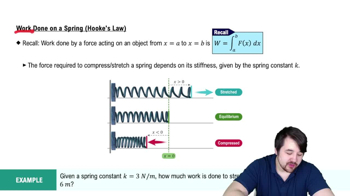
Work Done On A Spring (Hooke's Law)

Rational Functions

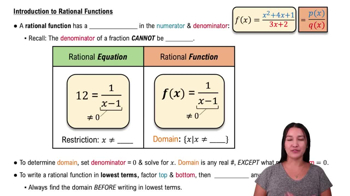
A rational function is a ratio of two polynomial functions. In the given example, the population function p(t) = 3500t / (t + 1) is a rational function where the numerator and denominator are both polynomials. Analyzing rational functions involves understanding their limits, asymptotic behavior, and potential steady states, which are critical for determining the long-term behavior of the system they represent.
추천 영상:
6:04
Intro to Rational Functions
관련 실천