Ch. 2 - Limits
Briggs - Calculus: Early Transcendentals 3rd Edition
Briggs3rd EditionCalculus: Early TranscendentalsISBN: 9780136847243당신이 사용하는 게 아니라요?교과서 변경
2장, 문제 48

Determine the following limits.
lim x→−∞ ex sin x

검증된 단계별 안내
1
Recognize that the problem involves finding the limit of the product of two functions as \( x \) approaches \(-\infty\).
Identify the two functions involved: \( e^x \) and \( \sin x \).
Recall that \( e^x \) approaches 0 as \( x \) approaches \(-\infty\).
Note that \( \sin x \) oscillates between -1 and 1 for all real \( x \).
Conclude that the product \( e^x \sin x \) approaches 0 as \( x \) approaches \(-\infty\) because \( e^x \) dominates the behavior of the product by approaching 0.

비슷한 문제에 대한 검증된 영상 답변:

이 영상 해법은 위 문제에 도움이 된다고 튜터들이 추천한 것입니다.
영상 길이:
4m
도움이 되었나요?

주요 개념

질문에 올바르게 답하기 위해 반드시 이해해야 하는 핵심 개념들은 다음과 같습니다.

Limits at Infinity

Limits at infinity involve evaluating the behavior of a function as the input approaches positive or negative infinity. Understanding how functions behave in these scenarios is crucial for determining their limits, especially when dealing with exponential and trigonometric functions.
추천 영상:
05:50
One-Sided Limits

Exponential Functions

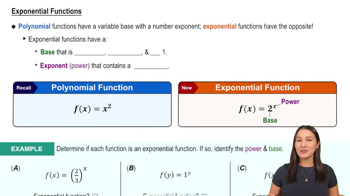
Exponential functions, such as e^x, grow rapidly as x increases and approach zero as x decreases towards negative infinity. This characteristic is essential for analyzing the limit of e^x as x approaches negative infinity, which significantly influences the overall limit of the expression.
추천 영상:
6:13
Exponential Functions

Trigonometric Functions

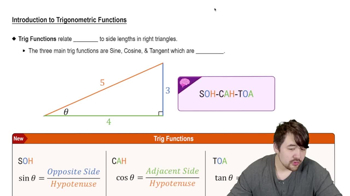
Trigonometric functions like sin(x) oscillate between -1 and 1, regardless of the value of x. This periodic behavior means that while sin(x) does not converge to a single value, its bounded nature plays a critical role in determining the limit of the product e^x sin(x) as x approaches negative infinity.
추천 영상:
가이드 코스
6:04
Introduction to Trigonometric Functions