Ch. 2 - Limits
Briggs - Calculus: Early Transcendentals 3rd Edition
Briggs3rd EditionCalculus: Early TranscendentalsISBN: 9780136847243당신이 사용하는 게 아니라요?교과서 변경
2장, 문제 2.37

Evaluate each limit and justify your answer. 
lim x→5 ln 6(√x^2−16−3) / 5x−25

검증된 단계별 안내
1
Step 1: Recognize that the limit involves a rational function where both the numerator and the denominator approach 0 as x approaches 5. This is an indeterminate form of type 0/0, which suggests the use of L'Hôpital's Rule.
Step 2: Apply L'Hôpital's Rule, which states that if the limit of f(x)/g(x) as x approaches a value results in an indeterminate form 0/0 or ∞/∞, then the limit can be found by taking the derivative of the numerator and the derivative of the denominator separately.
Step 3: Differentiate the numerator ln(6(√x^2−16)−3) with respect to x. Use the chain rule and the derivative of the natural logarithm function. The derivative of ln(u) is 1/u * du/dx, where u = 6(√x^2−16)−3.
Step 4: Differentiate the denominator 5x−25 with respect to x. The derivative is straightforward since it is a linear function, resulting in 5.
Step 5: Evaluate the new limit using the derivatives obtained in Steps 3 and 4. Substitute x = 5 into the resulting expression to find the limit.

비슷한 문제에 대한 검증된 영상 답변:

이 영상 해법은 위 문제에 도움이 된다고 튜터들이 추천한 것입니다.
영상 길이:
5m
도움이 되었나요?

주요 개념

질문에 올바르게 답하기 위해 반드시 이해해야 하는 핵심 개념들은 다음과 같습니다.

Limits

Limits are fundamental in calculus, representing the value that a function approaches as the input approaches a certain point. They are essential for understanding continuity, derivatives, and integrals. In this question, evaluating the limit as x approaches 5 involves determining the behavior of the function near that point, which may require algebraic manipulation or applying limit laws.
추천 영상:
05:50
One-Sided Limits

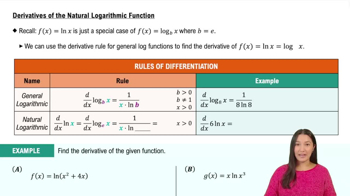
Natural Logarithm

The natural logarithm, denoted as ln, is the logarithm to the base e (approximately 2.718). It is a crucial function in calculus, particularly in problems involving growth rates and exponential functions. In the given limit, the natural logarithm of an expression is involved, which may affect the limit's evaluation, especially if the argument approaches zero or infinity.
추천 영상:
05:18
Derivative of the Natural Logarithmic Function

Indeterminate Forms

Indeterminate forms occur in calculus when evaluating limits leads to expressions like 0/0 or ∞/∞, which do not provide clear information about the limit's value. In this case, the limit may require techniques such as L'Hôpital's Rule or algebraic simplification to resolve. Recognizing and addressing indeterminate forms is crucial for correctly evaluating the limit presented in the question.
추천 영상:
가이드 코스
3:56
Slope-Intercept Form