Ch. 2 - Limits
Briggs - Calculus: Early Transcendentals 3rd Edition
Briggs3rd EditionCalculus: Early TranscendentalsISBN: 9780136847243당신이 사용하는 게 아니라요?교과서 변경
2장, 문제 2.3.59

Find the following limits or state that they do not exist. Assume a, b, c, and k are fixed real numbers.


limxxcos(x){\(\displaystyle\]\lim\)_{x\(\to\[\infty\)}{x\(\cos\]\left\)(x\(\right\))}}

검증된 단계별 안내
1
Recognize that the limit involves an oscillating function, \( \cos(x) \), which oscillates between -1 and 1.
Consider the behavior of \( x \cos(x) \) as \( x \to \infty \). The term \( x \) grows without bound, while \( \cos(x) \) continues to oscillate.
Use the Squeeze Theorem to analyze the limit. Since \( -1 \leq \cos(x) \leq 1 \), it follows that \( -x \leq x \cos(x) \leq x \).
Examine the limits of the bounding functions: \( \lim_{x \to \infty} -x = -\infty \) and \( \lim_{x \to \infty} x = \infty \).
Conclude that since the bounding functions tend to \( -\infty \) and \( \infty \), the limit \( \lim_{x \to \infty} x \cos(x) \) does not exist.

비슷한 문제에 대한 검증된 영상 답변:

이 영상 해법은 위 문제에 도움이 된다고 튜터들이 추천한 것입니다.
영상 길이:
1m
도움이 되었나요?

주요 개념

질문에 올바르게 답하기 위해 반드시 이해해야 하는 핵심 개념들은 다음과 같습니다.

Limits at Infinity

Limits at infinity involve evaluating the behavior of a function as the input approaches infinity. This concept is crucial for understanding how functions behave in extreme cases, particularly for determining whether they approach a finite value, diverge, or oscillate. In this context, we analyze the limit of the function as x approaches infinity to ascertain its long-term behavior.
추천 영상:
05:50
One-Sided Limits

Oscillatory Behavior

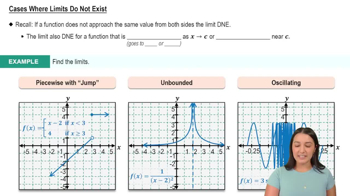
Oscillatory behavior refers to functions that do not settle at a single value as their input increases but instead fluctuate between values. The cosine function, for example, oscillates between -1 and 1. When combined with a term that grows without bound, such as x in this limit, it can lead to indeterminate forms, necessitating careful analysis to determine the limit's existence.
추천 영상:
03:07
Cases Where Limits Do Not Exist

Squeeze Theorem

The Squeeze Theorem is a method used to find limits of functions that are difficult to evaluate directly. It states that if a function is 'squeezed' between two other functions that converge to the same limit, then the squeezed function must also converge to that limit. This theorem is particularly useful in cases where oscillatory functions are involved, as it can help establish the limit's behavior by bounding it.
추천 영상:
05:12
Finding Global Extrema (Extreme Value Theorem)