Ch. 2 - Limits
Briggs - Calculus: Early Transcendentals 3rd Edition
Briggs3rd EditionCalculus: Early TranscendentalsISBN: 9780136847243당신이 사용하는 게 아니라요?교과서 변경
2장, 문제 2.2

Evaluate lim x→∞ f(x) and lim x→−∞ f(x) sing the figure. <IMAGE>

검증된 단계별 안내
1
insert step 1
insert step 2
insert step 3
insert step 4
insert step 5

비슷한 문제에 대한 검증된 영상 답변:

이 영상 해법은 위 문제에 도움이 된다고 튜터들이 추천한 것입니다.
영상 길이:
2m
도움이 되었나요?

주요 개념

질문에 올바르게 답하기 위해 반드시 이해해야 하는 핵심 개념들은 다음과 같습니다.

Limits at Infinity

Limits at infinity refer to the behavior of a function as the input approaches positive or negative infinity. This concept helps determine the end behavior of functions, indicating whether they approach a specific value, diverge, or oscillate. Understanding limits at infinity is crucial for analyzing functions in calculus, especially when evaluating horizontal asymptotes.
추천 영상:
05:50
One-Sided Limits

Horizontal Asymptotes

Horizontal asymptotes are lines that a graph approaches as the input values become very large or very small. They indicate the value that a function approaches as x approaches infinity or negative infinity. Identifying horizontal asymptotes is essential for understanding the long-term behavior of rational functions and can be determined using limits.
추천 영상:
5:46
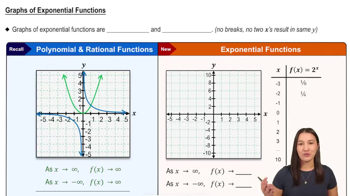
Graphs of Exponential Functions

Graphical Interpretation

Graphical interpretation involves analyzing the visual representation of a function to understand its behavior, including limits and asymptotes. By examining the graph, one can identify trends, such as where the function stabilizes or diverges, which aids in evaluating limits at infinity. This concept emphasizes the importance of visualizing mathematical functions to enhance comprehension.
추천 영상:
05:02
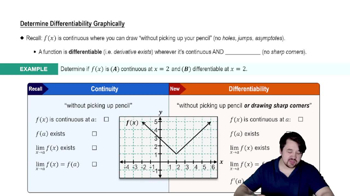
Determining Differentiability Graphically