Ch. 2 - Limits
Briggs - Calculus: Early Transcendentals 3rd Edition
Briggs3rd EditionCalculus: Early TranscendentalsISBN: 9780136847243당신이 사용하는 게 아니라요?교과서 변경
2장, 문제 2.7.1

Suppose x lies in the interval (1, 3) with x≠2. Find the smallest positive value of δ such that the inequality 0<|x−2|<δ is true.

검증된 단계별 안내
1
Understand the problem: We need to find the smallest positive value of δ such that the inequality 0 < |x−2| < δ holds true for x in the interval (1, 3) with x ≠ 2.
Consider the interval (1, 3) and identify the points where x is closest to 2. Since x ≠ 2, we need to consider the values of x approaching 2 from both sides within the interval.
Calculate the distance from 2 to the endpoints of the interval. The distance from 2 to 1 is |2 - 1| = 1, and the distance from 2 to 3 is |3 - 2| = 1.
Since x cannot be equal to 2, the smallest positive value of δ must be less than the smallest distance from 2 to the endpoints of the interval, which is 1.
Conclude that the smallest positive value of δ is slightly less than 1, ensuring that 0 < |x−2| < δ holds true for all x in the interval (1, 3) with x ≠ 2.

비슷한 문제에 대한 검증된 영상 답변:

이 영상 해법은 위 문제에 도움이 된다고 튜터들이 추천한 것입니다.
영상 길이:
3m

주요 개념

질문에 올바르게 답하기 위해 반드시 이해해야 하는 핵심 개념들은 다음과 같습니다.

Absolute Value Inequality

An absolute value inequality of the form |x - a| < δ describes the distance between x and a being less than δ. In this context, it means that x is within δ units of the point a (which is 2 here). Understanding this concept is crucial for determining the range of x values that satisfy the inequality.
추천 영상:
가이드 코스
06:37
Average Value of a Function

Intervals

An interval is a set of real numbers that lie between two endpoints. The interval (1, 3) indicates that x can take any value greater than 1 and less than 3, excluding the endpoints. This concept is important for identifying the valid values of x that can be used in the inequality.
추천 영상:
03:38
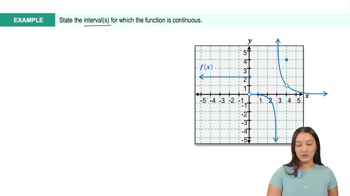
Intro to Continuity Example 1

Limit and Continuity

In calculus, limits describe the behavior of a function as it approaches a certain point. The condition x ≠ 2 implies that we are examining the behavior of x as it approaches 2 from either side, which is essential for understanding how δ can be chosen to maintain the inequality while respecting the constraints of the interval.
추천 영상:
05:34
Intro to Continuity