Ch. 2 - Limits
Briggs - Calculus: Early Transcendentals 3rd Edition
Briggs3rd EditionCalculus: Early TranscendentalsISBN: 9780136847243당신이 사용하는 게 아니라요?교과서 변경
2장, 문제 12d

Graph the function f(x)=e^−x / x(x+2)^2 using a graphing utility. (Experiment with your choice of a graphing window.) Use your graph to determine the following limits.


d. lim x→0^+ f(x)

검증된 단계별 안내
1
Identify the function: \( f(x) = \frac{e^{-x}}{x(x+2)^2} \).
Focus on the limit as \( x \to 0^+ \), which means approaching 0 from the right.
Consider the behavior of each part of the function as \( x \to 0^+ \): \( e^{-x} \to 1 \), \( x \to 0^+ \), and \( (x+2)^2 \to 4 \).
Analyze the expression \( \frac{1}{x} \) as \( x \to 0^+ \), which tends to infinity.
Conclude that the limit \( \lim_{x \to 0^+} f(x) \) depends on the behavior of \( \frac{1}{x} \) and the other terms.

비슷한 문제에 대한 검증된 영상 답변:

이 영상 해법은 위 문제에 도움이 된다고 튜터들이 추천한 것입니다.
영상 길이:
1m
도움이 되었나요?

주요 개념

질문에 올바르게 답하기 위해 반드시 이해해야 하는 핵심 개념들은 다음과 같습니다.

Limits

A limit is a fundamental concept in calculus that describes the behavior of a function as its input approaches a certain value. It helps in understanding the function's behavior near points of interest, including points where the function may not be explicitly defined. In this case, evaluating the limit as x approaches 0 from the right (0+) is crucial for determining the function's behavior near that point.
추천 영상:
05:50
One-Sided Limits

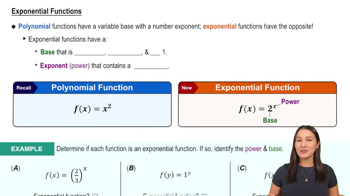
Exponential Functions

Exponential functions are mathematical functions of the form f(x) = a * e^(bx), where e is Euler's number (approximately 2.71828). In the given function f(x) = e^(-x) / (x(x+2)^2), the exponential component e^(-x) influences the function's growth or decay as x changes. Understanding how exponential functions behave as x approaches certain values is essential for analyzing limits.
추천 영상:
6:13
Exponential Functions

Graphing Rational Functions

Rational functions are ratios of polynomials, and their graphs can reveal important information about their limits and asymptotic behavior. The function f(x) = e^(-x) / (x(x+2)^2) is a rational function, and graphing it allows for visualizing its behavior near critical points, such as x = 0. Analyzing the graph helps in determining the limit as x approaches 0 from the right, as well as identifying any vertical or horizontal asymptotes.
추천 영상:
가이드 코스
5:53
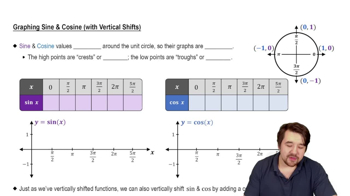
Graph of Sine and Cosine Function
관련 실천
교과서 질문

The position of an object moving vertically along a line is given by the function s(t)=16t2+128ts\(\left\)(t\(\right\))=-16t^2+128t. Find the average velocity of the object over the following intervals.

[1,4]\(\left\[\lbrack\)1,4\(\right\]\rbrack\)

378
views
교과서 질문

Graph the function f(x)=e^−x / x(x+2)^2 using a graphing utility. (Experiment with your choice of a graphing window.) Use your graph to determine the following limits.


c. lim x→0^− f(x)

275
views
교과서 질문

Determine the following limits.

lim h→0 (h + 6)^2 + (h + 6) − 42 / h

358
views
교과서 질문

Given the function f(x)=16x2+64xf\(\left\)(x\(\right\))=-16x^2+64x, complete the following. <IMAGE>

Find the slopes of the secant lines that pass though the points (x,f(x))\(\left\)(x,f\(\left\)(x\(\right\))\(\right\)) and (2,f(2))\(\left\)(2,f\(\left\)(2\(\right\))\(\right\)), for x=1.5,1.9,1.99,1.999,x=1.5,1.9,1.99,1.999, and 1.99991.9999 (see figure).

409
views
교과서 질문

The position of an object moving vertically along a line is given by the function s(t)=16t2+128ts\(\left\)(t\(\right\))=-16t^2+128t. Find the average velocity of the object over the following intervals.

[1,2]\(\left\[\lbrack\)1,2\(\right\]\rbrack\)

397
views
교과서 질문

Given the function f(x)=16x2+64xf\(\left\)(x\(\right\))=-16x^2+64x, complete the following. <IMAGE>

Make a conjecture about the value of the limit of the slopes of the secant lines that pass through (x,f(x))\(\left\)(x,f\(\left\)(x\(\right\))\(\right\)) and (2,f(2))\(\left\)(2,f\(\left\)(2\(\right\))\(\right\)) as xx approaches 22.

319
views