A spherical snowball melts at a rate proportional to its surface area. Show that the rate of change of the radius is constant. (Hint: Surface area=4πr².)
Ch. 3 - Derivatives
3장, 문제 3.10.54
47–56. Derivatives of inverse functions at a point Consider the following functions. In each case, without finding the inverse, evaluate the derivative of the inverse at the given point.
f(x)=4e^10x; (4,0)
검증된 단계별 안내1
Step 1: Understand the problem. We need to find the derivative of the inverse function of f(x) = 4e^{10x} at the point (4, 0). This means we need to find (f^{-1})'(0).
Step 2: Use the formula for the derivative of an inverse function. If y = f(x) and f is invertible, then the derivative of the inverse function at a point is given by (f^{-1})'(y) = 1 / f'(x), where f(x) = y.
Step 3: Identify the point of interest. We are given the point (4, 0), which means f(x) = 4 when x = 0. Therefore, we need to find f'(0).
Step 4: Differentiate the function f(x) = 4e^{10x}. The derivative f'(x) is found using the chain rule: f'(x) = 4 * 10 * e^{10x} = 40e^{10x}.
Step 5: Evaluate the derivative at x = 0. Substitute x = 0 into f'(x) to find f'(0) = 40e^{0} = 40. Now, use the inverse derivative formula: (f^{-1})'(0) = 1 / f'(0) = 1 / 40.

비슷한 문제에 대한 검증된 영상 답변:
이 영상 해법은 위 문제에 도움이 된다고 튜터들이 추천한 것입니다.
영상 길이:
4m도움이 되었나요?
주요 개념
질문에 올바르게 답하기 위해 반드시 이해해야 하는 핵심 개념들은 다음과 같습니다.
Inverse Functions
Inverse functions are functions that 'reverse' the effect of the original function. If f(x) takes an input x and produces an output y, then the inverse function f⁻¹(y) takes y back to x. Understanding how to find and work with inverse functions is crucial for evaluating derivatives of inverses.
추천 영상:
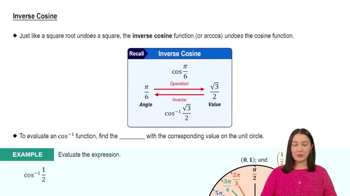
Inverse Cosine
Derivative of Inverse Functions
The derivative of an inverse function can be calculated using the formula (f⁻¹)'(y) = 1 / f'(x), where y = f(x). This relationship shows how the rate of change of the inverse function at a point is related to the rate of change of the original function at the corresponding point. This concept is essential for solving problems involving derivatives of inverse functions.
추천 영상:
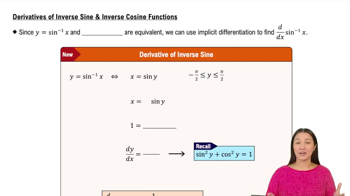
Derivatives of Inverse Sine & Inverse Cosine
Exponential Functions and Their Derivatives
Exponential functions, such as f(x) = 4e^(10x), have specific properties and derivatives. The derivative of an exponential function is proportional to the function itself, specifically f'(x) = k * e^(kx) for some constant k. Understanding how to differentiate exponential functions is necessary for applying the derivative of the inverse function formula.
추천 영상:
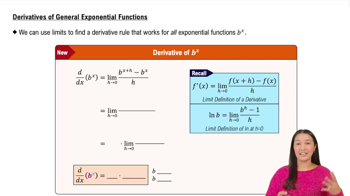
Derivatives of General Exponential Functions
관련 실천
교과서 질문
384
views
교과서 질문
Find the derivative of the following functions.
y = cos x/sin x + 1
355
views
교과서 질문
A surface ship is moving (horizontally) in a straight line at 10 km/hr. At the same time, an enemy submarine maintains a position directly below the ship while diving at an angle that is 20° below the horizontal. How fast is the submarine’s altitude decreasing?
292
views
교과서 질문
15–48. Derivatives Find the derivative of the following functions.
y = In (x³+1)^π
366
views
교과서 질문
Find the derivative of the following functions.
y = x sin x
331
views
교과서 질문
23–51. Calculating derivatives Find the derivative of the following functions.
y = a sin x + b cos x/a sin x - b cos x; a and b are nonzero constants
309
views