


Angle to a particle (part 2) The figure in Exercise 81 shows the particle traveling away from the sensor, which may have influenced your solution (we expect you used the inverse sine function). Suppose instead that the particle approaches the sensor (see figure). How would this change the solution? Explain the differences in the two answers. <IMAGE>
Ch. 3 - Derivatives
3장, 문제 3.9.51
49–55. Derivatives of tower functions (or g^h) Find the derivative of each function and evaluate the derivative at the given value of a.
h (x) = x^√x; a = 4
검증된 단계별 안내1
Identify the function h(x) = x^√x. This is a tower function where the base and the exponent are both functions of x.
Rewrite the function using logarithms to simplify differentiation: h(x) = e^(√x * ln(x)). This transformation uses the property that a^b = e^(b * ln(a)).
Differentiate the transformed function using the chain rule. Let u(x) = √x * ln(x), then h(x) = e^u(x). The derivative of h(x) is h'(x) = e^u(x) * u'(x).
Find the derivative of u(x) = √x * ln(x) using the product rule: u'(x) = (1/(2√x)) * ln(x) + (√x/x).
Evaluate the derivative h'(x) at x = 4 by substituting x = 4 into the expression for h'(x) obtained in the previous steps.

비슷한 문제에 대한 검증된 영상 답변:
이 영상 해법은 위 문제에 도움이 된다고 튜터들이 추천한 것입니다.
영상 길이:
9m주요 개념
질문에 올바르게 답하기 위해 반드시 이해해야 하는 핵심 개념들은 다음과 같습니다.
Derivatives
A derivative represents the rate of change of a function with respect to its variable. It is a fundamental concept in calculus that allows us to determine the slope of the tangent line to the curve of a function at any given point. The derivative can be computed using various rules, such as the power rule, product rule, and chain rule, depending on the form of the function.
추천 영상:
가이드 코스
Derivatives
Tower Functions
Tower functions, such as g^h, involve exponentiation where the base and the exponent can be functions themselves. In the case of h(x) = x^√x, the function is defined as x raised to the power of the square root of x. Understanding how to differentiate these types of functions requires applying the chain rule and recognizing the structure of the function as a composition of simpler functions.
추천 영상:
가이드 코스
Properties of Functions
Evaluating Derivatives
Evaluating a derivative at a specific point involves substituting the value of the variable into the derivative function after it has been computed. This process provides the instantaneous rate of change of the original function at that particular point. In this case, evaluating the derivative of h(x) at a = 4 will yield the slope of the tangent line to the curve at that point.
추천 영상:
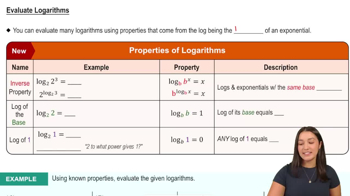
Evaluate Logarithms
관련 실천
교과서 질문
133
views
교과서 질문
Consider the curve x=e^y. Use implicit differentiation to verify that dy/dx = e^-y and then find d²y/dx² .
340
views
교과서 질문
A cost function of the form C(x) = 1/2x² reflects diminishing returns to scale. Find and graph the cost, average cost, and marginal cost functions. Interpret the graphs and explain the idea of diminishing returns.
202
views
교과서 질문
Find y'' for the following functions.
y = cos θ sin θ
298
views
교과서 질문
Evaluate the derivative of the following functions.
f(x) = sin-1 (e-2x)
204
views
교과서 질문
15–48. Derivatives Find the derivative of the following functions.
y = 10^In 2x
362
views
