Find d/dx(ln√x²+1).
Ch. 3 - Derivatives
3장, 문제 3.10.82
Angle to a particle (part 2) The figure in Exercise 81 shows the particle traveling away from the sensor, which may have influenced your solution (we expect you used the inverse sine function). Suppose instead that the particle approaches the sensor (see figure). How would this change the solution? Explain the differences in the two answers. <IMAGE>
검증된 단계별 안내1
Consider the scenario where the particle is approaching the sensor. This changes the direction of the velocity vector relative to the sensor.
In the original problem, the particle was moving away, which likely led to using the inverse sine function to determine the angle based on the geometry of the situation.
When the particle approaches the sensor, the angle calculation involves considering the opposite direction of motion. This might require using the inverse cosine function instead, depending on the specific trigonometric relationships involved.
The key difference in the two scenarios is the sign and direction of the velocity vector relative to the sensor, which affects the trigonometric function used to calculate the angle.
To solve the problem, set up the trigonometric relationship based on the new direction of motion, and solve for the angle using the appropriate inverse trigonometric function, ensuring to account for the direction of approach.

비슷한 문제에 대한 검증된 영상 답변:
이 영상 해법은 위 문제에 도움이 된다고 튜터들이 추천한 것입니다.
영상 길이:
4m주요 개념
질문에 올바르게 답하기 위해 반드시 이해해야 하는 핵심 개념들은 다음과 같습니다.
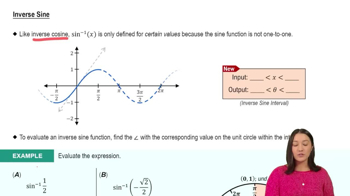
Inverse Sine Function
The inverse sine function, denoted as sin⁻¹ or arcsin, is used to determine the angle whose sine is a given value. In the context of particle motion, it helps relate the angle of elevation or depression to the position of the particle relative to a sensor. Understanding how to apply this function is crucial for analyzing the angle changes as the particle approaches or moves away from the sensor.
추천 영상:
Inverse Sine
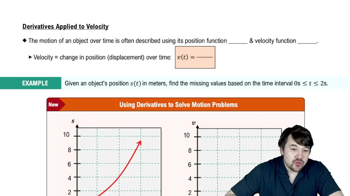
Particle Motion
Particle motion refers to the movement of an object along a path, which can be described using various parameters such as position, velocity, and acceleration. In this scenario, the direction of the particle's motion (approaching or receding from the sensor) significantly affects the angle measurement and the resulting calculations. Recognizing how these dynamics influence the angle is essential for solving the problem.
추천 영상:
가이드 코스
Derivatives Applied To Velocity
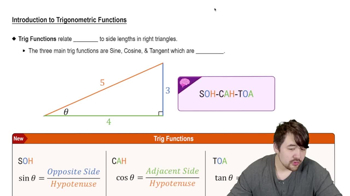
Trigonometric Relationships
Trigonometric relationships, particularly those involving right triangles, are fundamental in relating angles to side lengths. In this case, as the particle's position changes, the corresponding angles and distances to the sensor will also change, impacting the calculations. A solid grasp of these relationships is necessary to understand how the angle of approach alters the solution compared to when the particle is moving away.
추천 영상:
가이드 코스
Introduction to Trigonometric Functions
관련 실천
교과서 질문
219
views
교과서 질문
49–55. Derivatives of tower functions (or g^h) Find the derivative of each function and evaluate the derivative at the given value of a.
h (x) = x^√x; a = 4
157
views

교과서 질문
Consider the curve x=e^y. Use implicit differentiation to verify that dy/dx = e^-y and then find d²y/dx² .
340
views
교과서 질문
75–86. Logarithmic differentiation Use logarithmic differentiation to evaluate f'(x).
f(x) = tan¹⁰x / (5x+3)⁶
178
views
교과서 질문
15–48. Derivatives Find the derivative of the following functions.
y = 10^In 2x
362
views
교과서 질문
A 12-ft ladder is leaning against a vertical wall when Jack begins pulling the foot of the ladder away from the wall at a rate of 0.2 ft/s. What is the configuration of the ladder at the instant when the vertical speed of the top of the ladder equals the horizontal speed of the foot of the ladder?
260
views