
Ch. 3 - Derivatives
Briggs - Calculus: Early Transcendentals 3rd Edition
Briggs3rd EditionCalculus: Early TranscendentalsISBN: 9780136847243당신이 사용하는 게 아니라요?교과서 변경
3장, 문제 3.9.97b

97–100. Logistic growth Scientists often use the logistic growth function P(t) = P₀K / P₀+(K−P₀)e^−r₀t to model population growth, where P₀ is the initial population at time t=0, K is the carrying capacity, and r₀ is the base growth rate. The carrying capacity is a theoretical upper bound on the total population that the surrounding environment can support. The figure shows the sigmoid (S-shaped) curve associated with a typical logistic model. <IMAGE>


{Use of Tech} Gone fishing When a reservoir is created by a new dam, 50 fish are introduced into the reservoir, which has an estimated carrying capacity of 8000 fish. A logistic model of the fish population is P(t) = 400,000 / 50+7950e^−0.5t, where t is measured in years.


b. How long does it take for the population to reach 5000 fish? How long does it take for the population to reach 90% of the carrying capacity?

검증된 단계별 안내
1
Identify the logistic growth function given in the problem: P(t) = \(\frac{400,000}{50 + 7950e^{-0.5t}\)}.
To find the time it takes for the population to reach 5000 fish, set P(t) = 5000 and solve for t: \(\frac{400,000}{50 + 7950e^{-0.5t}\)} = 5000.
Rearrange the equation to isolate the exponential term: 50 + 7950e^{-0.5t} = \(\frac{400,000}{5000}\).
Calculate \(\frac{400,000}{5000}\) to simplify the equation: 50 + 7950e^{-0.5t} = 80.
Subtract 50 from both sides and solve for e^{-0.5t}: 7950e^{-0.5t} = 30. Then, divide both sides by 7950 and take the natural logarithm to solve for t.

비슷한 문제에 대한 검증된 영상 답변:

이 영상 해법은 위 문제에 도움이 된다고 튜터들이 추천한 것입니다.
영상 길이:
7m
도움이 되었나요?

주요 개념

질문에 올바르게 답하기 위해 반드시 이해해야 하는 핵심 개념들은 다음과 같습니다.

Logistic Growth Model

The logistic growth model describes how a population grows in a limited environment, characterized by an initial exponential growth phase followed by a slowdown as the population approaches a maximum capacity, known as the carrying capacity (K). The model is represented by the equation P(t) = P₀K / (P₀ + (K - P₀)e^(-r₀t)), where P₀ is the initial population, r₀ is the growth rate, and t is time. This S-shaped curve illustrates how populations stabilize as resources become scarce.
추천 영상:
04:39
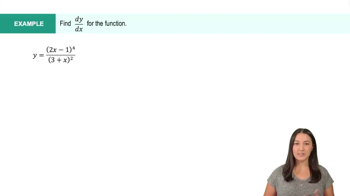
Derivative of the Natural Logarithmic Function Example 7

Carrying Capacity

Carrying capacity (K) refers to the maximum population size that an environment can sustain indefinitely without degrading the habitat. In the context of the logistic growth model, it acts as a threshold that limits population growth as resources become limited. Understanding carrying capacity is crucial for predicting population dynamics and managing ecological systems, as it helps determine when a population will stabilize.
추천 영상:
07:39
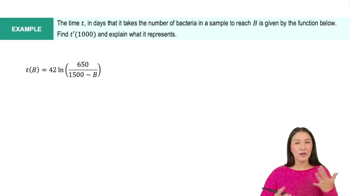
Intro to the Chain Rule Example 2

Exponential Growth and Decay

Exponential growth occurs when the growth rate of a population is proportional to its current size, leading to rapid increases when resources are abundant. Conversely, exponential decay describes a decrease in population size when resources are limited or when mortality rates exceed birth rates. In logistic growth, the initial phase often resembles exponential growth until the effects of limited resources begin to slow the growth, transitioning the population towards the carrying capacity.
추천 영상:
6:13
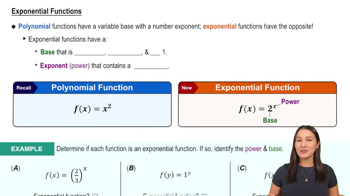
Exponential Functions
관련 실천
교과서 질문

45–50. Tangent lines Carry out the following steps. <IMAGE>

b. Determine an equation of the line tangent to the curve at the given point.

x³+y³=2xy; (1, 1)

269
views
교과서 질문

Deriving trigonometric identities

b. Verify that you obtain the same identity for sin2t as in part (a) if you differentiate the identity cos 2t = 2 cos² t−1.

374
views
교과서 질문

58–59. Carry out the following steps.

b. Find the slope of the curve at the given point.

xy^5/2+x^3/2y=12; (4, 1)

310
views
교과서 질문

{Use of Tech} Spring oscillations A spring hangs from the ceiling at equilibrium with a mass attached to its end. Suppose you pull downward on the mass and release it 10 inches below its equilibrium position with an upward push. The distance x (in inches) of the mass from its equilibrium position after t seconds is given by the function x(t) = 10sin t - 10cos t, where x is positive when the mass is above the equilibrium position. <IMAGE>

b. Find dx/dt and interpret the meaning of this derivative.  

208
views
교과서 질문

{Use of Tech} Computing limits with angles in degrees Suppose your graphing calculator has two functions, one called sin x, which calculates the sine of x when x is in radians, and the other called s(x), which calculates the sine of x when x is in degrees.

b. Evaluate lim x→0 s(x) / x. Verify your answer by estimating the limit on your calculator.

318
views
교과서 질문

45–50. Tangent lines Carry out the following steps. <IMAGE>

b. Determine an equation of the line tangent to the curve at the given point.

x⁴-x²y+y⁴=1; (−1, 1)

220
views