
Ch. 3 - Derivatives
Briggs - Calculus: Early Transcendentals 3rd Edition
Briggs3rd EditionCalculus: Early TranscendentalsISBN: 9780136847243당신이 사용하는 게 아니라요?교과서 변경
3장, 문제 3.6.57b

A race Jean and Juan run a one-lap race on a circular track. Their angular positions on the track during the race are given by the functions θ(t) and ϕ(t), respectively, where 0≤t≤4 and t is measured in minutes (see figure). These angles are measured in radians, where θ=ϕ=0 represent the starting position and θ=ϕ=2π represent the finish position. The angular velocities of the runners are θ′(t) and ϕ′(t). <IMAGE>
b. Which runner has the greater average angular velocity?

검증된 단계별 안내
1
To find the average angular velocity of each runner, we need to use the formula for average angular velocity, which is the total change in angular position divided by the total time taken. Mathematically, this is expressed as: \( \text{Average Angular Velocity} = \frac{\Delta \theta}{\Delta t} \) for Jean and \( \frac{\Delta \phi}{\Delta t} \) for Juan.
Determine the total change in angular position for each runner. Since both start at \( \theta = 0 \) and \( \phi = 0 \) and finish at \( \theta = 2\pi \) and \( \phi = 2\pi \), the change in angular position for both runners is \( 2\pi \) radians.
The total time for the race is given as \( \Delta t = 4 \) minutes.
Calculate the average angular velocity for Jean using the formula: \( \text{Average Angular Velocity for Jean} = \frac{2\pi}{4} \).
Calculate the average angular velocity for Juan using the formula: \( \text{Average Angular Velocity for Juan} = \frac{2\pi}{4} \). Compare the two values to determine which runner has the greater average angular velocity.

비슷한 문제에 대한 검증된 영상 답변:

이 영상 해법은 위 문제에 도움이 된다고 튜터들이 추천한 것입니다.
영상 길이:
3m

주요 개념

질문에 올바르게 답하기 위해 반드시 이해해야 하는 핵심 개념들은 다음과 같습니다.

Angular Position

Angular position refers to the angle that an object has rotated from a reference point, typically measured in radians. In the context of the race, θ(t) and ϕ(t) represent the angular positions of Jean and Juan over time, indicating their respective locations on the circular track. Understanding angular position is crucial for determining how far each runner has traveled around the track.
추천 영상:
가이드 코스
06:29
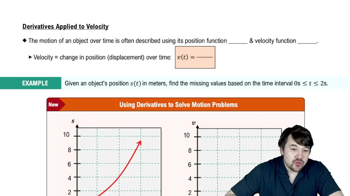
Derivatives Applied To Velocity

Angular Velocity

Angular velocity is a measure of how quickly an object rotates around a point, expressed as the rate of change of angular position with respect to time. It is denoted as θ′(t) for Jean and ϕ′(t) for Juan. To compare the average angular velocities of the two runners, one must calculate the change in their angular positions over the time interval, which provides insight into their speed around the track.
추천 영상:
가이드 코스
06:29
Derivatives Applied To Velocity

Average Angular Velocity

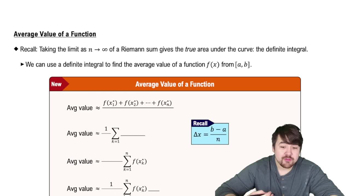
Average angular velocity is defined as the total change in angular position divided by the total time taken. For the runners, it can be calculated using the formula (θ(final) - θ(initial)) / (t(final) - t(initial)) for Jean and similarly for Juan. This concept is essential for determining which runner has a greater average angular velocity over the course of the race, allowing for a direct comparison of their performances.
추천 영상:
가이드 코스
06:37
Average Value of a Function
관련 실천
교과서 질문

97–100. Logistic growth Scientists often use the logistic growth function P(t) = P₀K / P₀+(K−P₀)e^−r₀t to model population growth, where P₀ is the initial population at time t=0, K is the carrying capacity, and r₀ is the base growth rate. The carrying capacity is a theoretical upper bound on the total population that the surrounding environment can support. The figure shows the sigmoid (S-shaped) curve associated with a typical logistic model. <IMAGE>


{Use of Tech} Gone fishing When a reservoir is created by a new dam, 50 fish are introduced into the reservoir, which has an estimated carrying capacity of 8000 fish. A logistic model of the fish population is P(t) = 400,000 / 50+7950e^−0.5t, where t is measured in years.


b. How long does it take for the population to reach 5000 fish? How long does it take for the population to reach 90% of the carrying capacity?

170
views
교과서 질문

Derivatives of inverse functions from a table Use the following tables to determine the indicated derivatives or state that the derivative cannot be determined. <IMAGE>

b. (f^-1)'(6)

200
views
교과서 질문

Witch of Agnesi Let y(x²+4)=8 (see figure). <IMAGE>

b. Find equations of all lines tangent to the curve y(x²+4)=8 when y=1.

262
views
교과서 질문

58–59. Carry out the following steps.

b. Find the slope of the curve at the given point.

xy^5/2+x^3/2y=12; (4, 1)

310
views
교과서 질문

45–50. Tangent lines Carry out the following steps. <IMAGE>

b. Determine an equation of the line tangent to the curve at the given point.

x⁴-x²y+y⁴=1; (−1, 1)

220
views
교과서 질문

City urbanization City planners model the size of their city using the function A(t) = - 1/50t² + 2t +20, for 0 ≤ t ≤ 50, where A is measured in square miles and t is the number of years after 2010.

b. How fast will the city be growing when it reaches a size of 38 mi²?

228
views