Ch. 3 - Derivatives
Briggs - Calculus: Early Transcendentals 3rd Edition
Briggs3rd EditionCalculus: Early TranscendentalsISBN: 9780136847243당신이 사용하는 게 아니라요?교과서 변경
3장, 문제 3.5.82

Another method for proving lim x→0 cos x−1/x = 0 Use the half-angle formula sin²x = 1− cos 2x/2 to prove that lim x→0 cos x−1/x=0.

검증된 단계별 안내
1
Start by recognizing that the limit we want to prove is lim x→0 (cos x - 1)/x = 0. This can be challenging directly, so we use trigonometric identities to simplify the expression.
Recall the half-angle identity: sin²x = (1 - cos 2x)/2. This identity can help us relate sine and cosine functions, which is useful for limits involving trigonometric functions.
To use this identity, consider the expression for sin²(x/2) = (1 - cos x)/2. This is derived by substituting x with x/2 in the half-angle formula.
Rearrange the expression to solve for cos x: cos x = 1 - 2sin²(x/2). This expression allows us to express cos x in terms of sin(x/2), which is useful for limits as x approaches 0.
Substitute cos x = 1 - 2sin²(x/2) into the original limit expression: (cos x - 1)/x = (1 - 2sin²(x/2) - 1)/x = -2sin²(x/2)/x. Now, analyze the behavior of this expression as x approaches 0, using the fact that sin(x/2) approaches 0 as x approaches 0.

비슷한 문제에 대한 검증된 영상 답변:

이 영상 해법은 위 문제에 도움이 된다고 튜터들이 추천한 것입니다.
영상 길이:
7m
도움이 되었나요?

주요 개념

질문에 올바르게 답하기 위해 반드시 이해해야 하는 핵심 개념들은 다음과 같습니다.

Limits

In calculus, a limit is a fundamental concept that describes the behavior of a function as its input approaches a certain value. It helps in understanding how functions behave near points of interest, particularly where they may not be explicitly defined. For example, evaluating the limit of a function as x approaches 0 can reveal insights about continuity and differentiability.
추천 영상:
05:50
One-Sided Limits

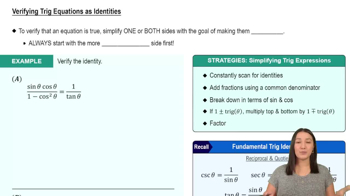
Trigonometric Identities

Trigonometric identities are equations that involve trigonometric functions and are true for all values of the variables involved. The half-angle formula, sin²x = (1 - cos(2x))/2, is a specific identity that relates the sine and cosine functions. These identities are essential for simplifying expressions and solving limits involving trigonometric functions.
추천 영상:
7:17
Verifying Trig Equations as Identities

L'Hôpital's Rule

L'Hôpital's Rule is a method in calculus used to evaluate limits of indeterminate forms, such as 0/0 or ∞/∞. It states that if the limit of f(x)/g(x) results in an indeterminate form, the limit can be found by taking the derivative of the numerator and the derivative of the denominator. This rule is particularly useful when direct substitution in limit problems leads to undefined expressions.
추천 영상:
관련 실천
교과서 질문

Find the function The following limits represent the slope of a curve y = f(x) at the point (a,f(a)). Determine a possible function f and number a; then calculate the limit.

(lim x🠂1) 3x²+4x-7 / x-1

238
views

교과서 질문

Two boats leave a port at the same time, one traveling west at 20 mi/hr and the other traveling southwest ( 45° south of west) at 15 mi/hr. After 30 minutes, how far apart are the boats and at what rate is the distance between them changing? (Hint: Use the Law of Cosines.)

326
views
교과서 질문

Find the derivative of the following functions.

y = In(e^x + e^-x)

337
views
교과서 질문

The line tangent to the graph of f at x=5 is y = 1/10x-2. Find d/dx (4f(x)) |x+5

232
views
교과서 질문

90–93. {Use of Tech} Work carefully Proceed with caution when using implicit differentiation to find points at which a curve has a specified slope. For the following curves, find the points on the curve (if they exist) at which the tangent line is horizontal or vertical. Once you have found possible points, make sure that they actually lie on the curve. Confirm your results with a graph.

x²(3y²−2y³) = 4

371
views
교과서 질문

73–78. {Use of Tech} Normal lines A normal line at a point P on a curve passes through P and is perpendicular to the line tangent to the curve at P (see figure). Use the following equations and graphs to determine an equation of the normal line at the given point. Illustrate your work by graphing the curve with the normal line. <IMAGE>


Exercise 48

231
views