Ch. 3 - Derivatives
Briggs - Calculus: Early Transcendentals 3rd Edition
Briggs3rd EditionCalculus: Early TranscendentalsISBN: 9780136847243당신이 사용하는 게 아니라요?교과서 변경
3장, 문제 3.8.91

90–93. {Use of Tech} Work carefully Proceed with caution when using implicit differentiation to find points at which a curve has a specified slope. For the following curves, find the points on the curve (if they exist) at which the tangent line is horizontal or vertical. Once you have found possible points, make sure that they actually lie on the curve. Confirm your results with a graph.
x²(3y²−2y³) = 4

검증된 단계별 안내
1
Start by differentiating the given equation implicitly with respect to x. The equation is x²(3y²−2y³) = 4. Use the product rule for differentiation, which states that if you have a product of two functions u(x) and v(x), then the derivative is u'(x)v(x) + u(x)v'(x).
Differentiate the left side of the equation: For x²(3y²−2y³), let u = x² and v = 3y²−2y³. The derivative of u with respect to x is 2x, and the derivative of v with respect to x involves implicit differentiation: d/dx(3y²−2y³) = 6y(dy/dx) - 6y²(dy/dx).
Apply the product rule: The derivative of x²(3y²−2y³) is 2x(3y²−2y³) + x²(6y(dy/dx) - 6y²(dy/dx)). Set this equal to the derivative of the right side, which is 0, since the derivative of a constant (4) is 0.
To find points where the tangent line is horizontal, set dy/dx = 0 and solve the resulting equation for x and y. This will give you the conditions under which the slope of the tangent is zero.
To find points where the tangent line is vertical, identify where the expression for dy/dx becomes undefined. This typically occurs when the denominator of the expression for dy/dx is zero. Solve for x and y under these conditions, and verify that these points lie on the original curve by substituting back into the original equation.

비슷한 문제에 대한 검증된 영상 답변:

이 영상 해법은 위 문제에 도움이 된다고 튜터들이 추천한 것입니다.
영상 길이:
9m
도움이 되었나요?

주요 개념

질문에 올바르게 답하기 위해 반드시 이해해야 하는 핵심 개념들은 다음과 같습니다.

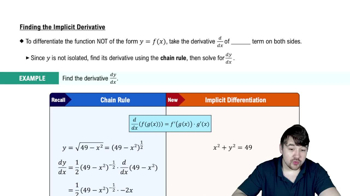
Implicit Differentiation

Implicit differentiation is a technique used to differentiate equations where the dependent and independent variables are not explicitly separated. Instead of solving for one variable in terms of the other, we differentiate both sides of the equation with respect to the independent variable, applying the chain rule as necessary. This method is particularly useful for finding derivatives of curves defined by equations that cannot be easily rearranged.
추천 영상:
05:14
Finding The Implicit Derivative

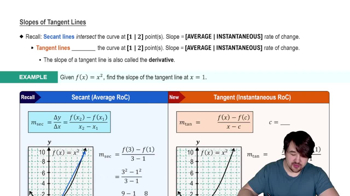
Tangent Lines and Slopes

The slope of a tangent line to a curve at a given point represents the instantaneous rate of change of the curve at that point. A horizontal tangent line indicates a slope of zero, while a vertical tangent line suggests an undefined slope. To find these points, we set the derivative equal to zero for horizontal tangents and check where the derivative does not exist for vertical tangents.
추천 영상:
05:13
Slopes of Tangent Lines

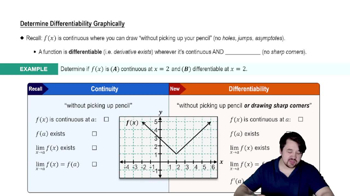
Graphical Confirmation

Graphical confirmation involves plotting the curve and visually inspecting the points where the tangent lines are horizontal or vertical. This step is crucial as it helps verify the analytical results obtained through differentiation. By comparing the calculated points with the graph, one can ensure that the identified points indeed lie on the curve and accurately represent the behavior of the function.
추천 영상:
05:02
Determining Differentiability Graphically