
교과서 질문
Calculate the derivative of the following functions.
y = csc ex
423
views

 검증된 단계별 안내
 05:44
05:44
 05:02
05:02 6:04
6:04Calculate the derivative of the following functions.
y = csc ex
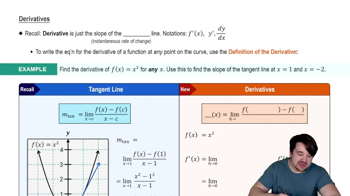
Derivatives and tangent lines
a. For the following functions and values of a, find f′(a).
f(x) = x²; a=3
A feather dropped on the moon On the moon, a feather will fall to the ground at the same rate as a heavy stone. Suppose a feather is dropped from a height of 40 m above the surface of the moon. Its height (in meters) above the ground after t seconds is s = 40−0.8t². Determine the velocity and acceleration of the feather the moment it strikes the surface of the moon.
Derivatives and tangent lines
b. Determine an equation of the line tangent to the graph of f at the point (a,f(a)) for the given value of a.
f(x) = x²; a=3
Determine whether the following statements are true and give an explanation or counterexample.
c. It is impossible for the instantaneous velocity at all times a≤t≤b to equal the average velocity over the interval a≤t≤b.
Find the derivative function f' for the following functions f.
f(x) =3x²+2x−10; a=1