
교과서 질문
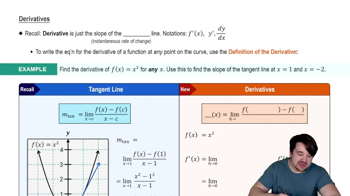
Derivatives and tangent lines
a. For the following functions and values of a, find f′(a).
f(x) = x²; a=3
206
views

 검증된 단계별 안내
 05:44
05:44
 6:22
6:22 05:02
05:02Derivatives and tangent lines
a. For the following functions and values of a, find f′(a).
f(x) = x²; a=3
Derivatives and tangent lines
b. Determine an equation of the line tangent to the graph of f at the point (a,f(a)) for the given value of a.
f(x) = x²; a=3
Demand and elasticity Based on sales data over the past year, the owner of a DVD store devises the demand function , where D(p) is the number of DVDs that can be sold in one day at a price of p dollars.
a. According to the model, how many DVDs can be sold in a day at a price of \$10?
Based on sales data over the past year, the owner of a DVD store devises the demand function D(p) = 40 - 2p, where D(p) is the number of DVDs that can be sold in one day at a price of p dollars.
For what prices is the demand elastic? Inelastic?
Based on sales data over the past year, the owner of a DVD store devises the demand function D(p) = 40 - 2p, where D(p) is the number of DVDs that can be sold in one day at a price of p dollars.
Find the elasticity function for this demand function.
Calculate the derivative of the following functions.
y = tan ex