Ch. 3 - Derivatives
Briggs - Calculus: Early Transcendentals 3rd Edition
Briggs3rd EditionCalculus: Early TranscendentalsISBN: 9780136847243당신이 사용하는 게 아니라요?교과서 변경
3장, 문제 3.7.25b

Derivatives using tables Let h(x)=f(g(x))h(x)=f(g(x)) and p(x)=g(f(x))p(x)=g(f(x)). Use the table to compute the following derivatives.
<IMAGE>
b. h(2)h^{\(\prime\)}\(\left\)(2\(\right\))

검증된 단계별 안내
1
Identify that h(x) = f(g(x)) is a composition of functions, which requires the use of the chain rule to find its derivative.
Recall the chain rule: if h(x) = f(g(x)), then h'(x) = f'(g(x)) * g'(x).
To find h'(2), substitute x = 2 into the derivative expression: h'(2) = f'(g(2)) * g'(2).
Use the table to find the values of g(2) and g'(2). Substitute these values into the expression.
Next, use the table to find f'(g(2)) by first finding g(2) and then using this result to find f' at that point. Substitute this value into the expression to complete the calculation of h'(2).

비슷한 문제에 대한 검증된 영상 답변:

이 영상 해법은 위 문제에 도움이 된다고 튜터들이 추천한 것입니다.
영상 길이:
2m

주요 개념

질문에 올바르게 답하기 위해 반드시 이해해야 하는 핵심 개념들은 다음과 같습니다.

Chain Rule

The Chain Rule is a fundamental theorem in calculus used to differentiate composite functions. It states that if a function h(x) is composed of two functions, f(g(x)), the derivative h'(x) can be found by multiplying the derivative of the outer function f with the derivative of the inner function g. Mathematically, this is expressed as h'(x) = f'(g(x)) * g'(x). Understanding this rule is essential for solving problems involving derivatives of composite functions.
추천 영상:
05:02
Intro to the Chain Rule

Derivative Notation

Derivative notation, such as h'(x) or f'(x), represents the rate of change of a function with respect to its variable. It indicates how the function's output changes as its input changes. In the context of the question, h'(2) specifically refers to the derivative of the function h evaluated at x = 2. Familiarity with this notation is crucial for interpreting and calculating derivatives correctly.
추천 영상:

Function Evaluation

Function evaluation involves substituting a specific value into a function to determine its output. In the context of derivatives, evaluating functions at certain points, such as h(2) or g(f(2)), is necessary to compute the derivative using the Chain Rule. This concept is vital for applying the derivatives obtained from the Chain Rule to find specific values, which is often required in calculus problems.
추천 영상:
가이드 코스
4:26
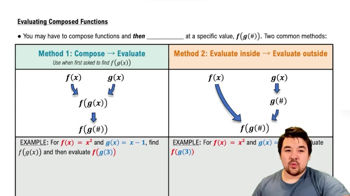
Evaluating Composed Functions
관련 실천
교과서 질문

13-26 Implicit differentiation Carry out the following steps.

b. Find the slope of the curve at the given point.

tan xy = x+y; (0,0)

184
views

교과서 질문

{Use of Tech} Angle of elevation A small plane, moving at 70 m/s, flies horizontally on a line 400 meters directly above an observer. Let θ be the angle of elevation of the plane (see figure). <IMAGE>


b. Graph dθ/dx as a function of x and determine the point at which θ changes most rapidly.

160
views
교과서 질문

Explain why or why not Determine whether the following statements are true and give an explanation or counterexample.

b. d/dx(tan^−1 x) =sec² x

149
views
교과서 질문

Derivatives and tangent lines

b. Determine an equation of the line tangent to the graph of f at the point (a,f(a)) for the given value of a.

f(x) = √3x; a= 12

227
views
교과서 질문

The energy (in joules) released by an earthquake of magnitude M is given by the equation E=25,000 ⋅ 101.5M. (This equation can be solved for M to define the magnitude of a given earthquake; it is a refinement of the original Richter scale created by Charles Richter in 1935.)

Compute dE/dM and evaluate it for M=3. What does this derivative mean? (M has no units, so the units of the derivative are J per change in magnitude.)

267
views
교과서 질문

{Use of Tech} A mixing tank A 500-liter (L) tank is filled with pure water. At time t=0, a salt solution begins flowing into the tank at a rate of 5 L/min. At the same time, the (fully mixed) solution flows out of the tank at a rate of 5.5 L/min. The mass of salt in grams in the tank at any time t≥0 is given by M(t) = 250(1000−t)(1−10−³⁰(1000−t)¹⁰) and the volume of solution in the tank is given by V(t) = 500-0.5t.

b. Graph the volume function and verify that the tank is empty when t=1000 min. 

275
views