Ch. 3 - Derivatives
Briggs - Calculus: Early Transcendentals 3rd Edition
Briggs3rd EditionCalculus: Early TranscendentalsISBN: 9780136847243당신이 사용하는 게 아니라요?교과서 변경
3장, 문제 3.10.61b

Explain why or why not Determine whether the following statements are true and give an explanation or counterexample.
b. d/dx(tan^−1 x) =sec² x

검증된 단계별 안내
1
To determine whether the statement \( \frac{d}{dx}(\tan^{-1} x) = \sec^2 x \) is true, we need to find the derivative of \( \tan^{-1} x \).
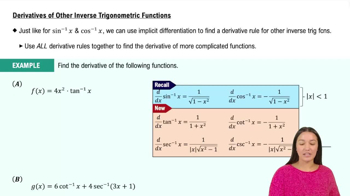
Recall that \( \tan^{-1} x \) is the inverse function of \( \tan x \). The derivative of \( \tan^{-1} x \) is given by the formula \( \frac{d}{dx}(\tan^{-1} x) = \frac{1}{1 + x^2} \).
Compare the derivative \( \frac{1}{1 + x^2} \) with \( \sec^2 x \). Note that \( \sec^2 x = 1 + \tan^2 x \), which is different from \( \frac{1}{1 + x^2} \).
Since \( \frac{1}{1 + x^2} \) is not equal to \( \sec^2 x \), the statement \( \frac{d}{dx}(\tan^{-1} x) = \sec^2 x \) is false.
Therefore, the correct derivative of \( \tan^{-1} x \) is \( \frac{1}{1 + x^2} \), not \( \sec^2 x \). This serves as a counterexample to the given statement.

비슷한 문제에 대한 검증된 영상 답변:

이 영상 해법은 위 문제에 도움이 된다고 튜터들이 추천한 것입니다.
영상 길이:
3m

주요 개념

질문에 올바르게 답하기 위해 반드시 이해해야 하는 핵심 개념들은 다음과 같습니다.

Derivative of Inverse Functions

The derivative of an inverse function can be found using the formula (d/dx)(f^−1(x)) = 1/(f'(f^−1(x))). For the function f(x) = tan(x), its inverse is f^−1(x) = tan^−1(x). Understanding this relationship is crucial for differentiating inverse trigonometric functions like tan^−1(x).
추천 영상:
07:26
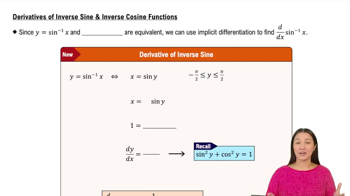
Derivatives of Inverse Sine & Inverse Cosine

Trigonometric Derivatives

Knowing the derivatives of basic trigonometric functions is essential. For example, the derivative of tan(x) is sec²(x). This knowledge helps in finding the derivative of its inverse, tan^−1(x), and is fundamental in verifying the correctness of derivative statements.
추천 영상:
06:35
Derivatives of Other Inverse Trigonometric Functions

Chain Rule

The chain rule is a fundamental principle in calculus used to differentiate composite functions. It states that if a function y = f(g(x)), then dy/dx = f'(g(x)) * g'(x). This rule is particularly useful when dealing with functions like tan^−1(x) that can be expressed in terms of other functions, aiding in the differentiation process.
추천 영상:
05:02
Intro to the Chain Rule
관련 실천
교과서 질문

Derivatives using tables Let h(x)=f(g(x))h(x)=f(g(x)) and p(x)=g(f(x))p(x)=g(f(x)). Use the table to compute the following derivatives.

<IMAGE>

b. h(2)h^{\(\prime\)}\(\left\)(2\(\right\))

278
views
교과서 질문

13-26 Implicit differentiation Carry out the following steps.

b. Find the slope of the curve at the given point.

³√x+³√y⁴ = 2;(1,1)

194
views
교과서 질문

13-26 Implicit differentiation Carry out the following steps.

b. Find the slope of the curve at the given point.

(x+y)^2/3=y; (4, 4)

271
views
교과서 질문

Derivatives and tangent lines

b. Determine an equation of the line tangent to the graph of f at the point (a,f(a)) for the given value of a.

f(x) = √3x; a= 12

227
views
교과서 질문

A differential equation is an equation involving an unknown function and its derivatives. Consider the differential equation y′′(t)+y(t) = 0.

b. Show that y = B cos t satisfies the equation for any constant B.

254
views
교과서 질문

{Use of Tech} A mixing tank A 500-liter (L) tank is filled with pure water. At time t=0, a salt solution begins flowing into the tank at a rate of 5 L/min. At the same time, the (fully mixed) solution flows out of the tank at a rate of 5.5 L/min. The mass of salt in grams in the tank at any time t≥0 is given by M(t) = 250(1000−t)(1−10−³⁰(1000−t)¹⁰) and the volume of solution in the tank is given by V(t) = 500-0.5t.

b. Graph the volume function and verify that the tank is empty when t=1000 min. 

275
views