Ch. 3 - Derivatives
Briggs - Calculus: Early Transcendentals 3rd Edition
Briggs3rd EditionCalculus: Early TranscendentalsISBN: 9780136847243당신이 사용하는 게 아니라요?교과서 변경
3장, 문제 3.5.66

Evaluate the following limits or state that they do not exist. (Hint: Identify each limit as the derivative of a function at a point.)
lim x→π/2 cos x/x−π/2

검증된 단계별 안내
1
Recognize that the given limit can be interpreted as the derivative of a function at a specific point. The expression lim x→π/2 (cos x)/(x−π/2) resembles the definition of a derivative.
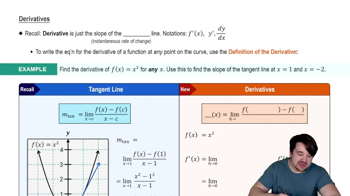
Recall the definition of the derivative of a function f at a point a: f'(a) = lim x→a (f(x) - f(a))/(x - a).
Identify the function f(x) = cos x and the point a = π/2. Notice that f(a) = cos(π/2) = 0.
Rewrite the limit in the form of the derivative definition: lim x→π/2 (cos x - cos(π/2))/(x - π/2). This matches the derivative definition for f(x) = cos x at x = π/2.
Conclude that the limit represents the derivative of f(x) = cos x at x = π/2, which is f'(π/2). To find this derivative, compute f'(x) = -sin x and evaluate it at x = π/2.

비슷한 문제에 대한 검증된 영상 답변:

이 영상 해법은 위 문제에 도움이 된다고 튜터들이 추천한 것입니다.
영상 길이:
2m
도움이 되었나요?

주요 개념

질문에 올바르게 답하기 위해 반드시 이해해야 하는 핵심 개념들은 다음과 같습니다.

Limits

A limit is a fundamental concept in calculus that describes the behavior of a function as its input approaches a certain value. It helps in understanding how functions behave near points of interest, including points where they may not be explicitly defined. Evaluating limits is crucial for determining continuity, derivatives, and integrals.
추천 영상:
05:50
One-Sided Limits

Derivatives

The derivative of a function at a point measures the rate at which the function's value changes as its input changes. It is defined as the limit of the average rate of change of the function over an interval as the interval approaches zero. In this context, recognizing the limit as a derivative allows for the application of derivative rules to evaluate the limit.
추천 영상:
05:44
Derivatives

L'Hôpital's Rule

L'Hôpital's Rule is a method for evaluating limits that result in indeterminate forms, such as 0/0 or ∞/∞. It states that if the limit of f(x)/g(x) leads to an indeterminate form, the limit can be found by taking the derivative of the numerator and the derivative of the denominator separately. This rule is particularly useful in simplifying complex limit problems.
추천 영상: