Ch. 3 - Derivatives
Briggs - Calculus: Early Transcendentals 3rd Edition
Briggs3rd EditionCalculus: Early TranscendentalsISBN: 9780136847243당신이 사용하는 게 아니라요?교과서 변경
3장, 문제 53a

Where is the function continuous? Differentiable? Use the graph of f in the figure to do the following. <IMAGE>
a. Find the values of x in (0, 3) at which f is not continuous.

검증된 단계별 안내
1
Identify the definition of continuity: A function f(x) is continuous at a point x = c if the following three conditions are met: 1) f(c) is defined, 2) the limit of f(x) as x approaches c exists, and 3) the limit of f(x) as x approaches c is equal to f(c).
Examine the graph of the function f in the interval (0, 3) to identify any points where the function might not be continuous. Look for any breaks, jumps, or holes in the graph.
For each point of interest identified in the previous step, check if f(x) is defined at that point. If f(x) is not defined, the function is not continuous at that point.
Next, check if the limit of f(x) as x approaches the point from both the left and the right exists and is equal. If the left-hand limit and the right-hand limit are not equal, the function is not continuous at that point.
Finally, verify if the limit of f(x) as x approaches the point is equal to f(c). If any of these conditions are not met, the function is not continuous at that point. List all such points in the interval (0, 3).

비슷한 문제에 대한 검증된 영상 답변:

이 영상 해법은 위 문제에 도움이 된다고 튜터들이 추천한 것입니다.
영상 길이:
2m
도움이 되었나요?

주요 개념

질문에 올바르게 답하기 위해 반드시 이해해야 하는 핵심 개념들은 다음과 같습니다.

Continuity of a Function

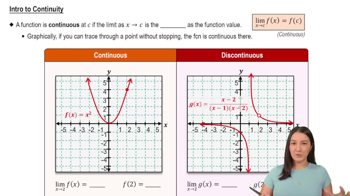
A function is continuous at a point if the limit of the function as it approaches that point equals the function's value at that point. This means there are no breaks, jumps, or holes in the graph of the function at that point. For a function to be continuous over an interval, it must be continuous at every point within that interval.
추천 영상:
05:34
Intro to Continuity

Differentiability of a Function

A function is differentiable at a point if it has a defined derivative at that point, which implies that the function is smooth and has no sharp corners or vertical tangents. Importantly, a function must be continuous at a point to be differentiable there, but continuity alone does not guarantee differentiability.
추천 영상:
가이드 코스
05:53
Finding Differentials

Identifying Discontinuities

Discontinuities in a function can occur in several forms, including removable, jump, and infinite discontinuities. To find where a function is not continuous, one must analyze the graph for any points where the function does not meet the criteria for continuity, such as breaks in the graph or undefined values. This analysis is crucial for determining the intervals of continuity and differentiability.
추천 영상:
03:38
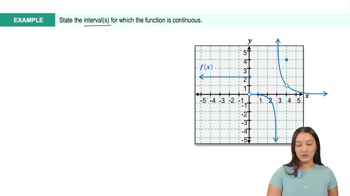
Intro to Continuity Example 1
관련 실천
교과서 질문

Where is the function continuous? Differentiable? Use the graph of f in the figure to do the following. <IMAGE>

c. Sketch a graph of f'.

146
views

교과서 질문

Where is the function continuous? Differentiable? Use the graph of f in the figure to do the following. <IMAGE>

b. Find the values of x in (0, 3) at which f is not differentiable.

188
views
교과서 질문

An angler hooks a trout and begins turning her circular reel at 1.5 rev/s. Assume the radius of the reel (and the fishing line on it) is 2 inches.

a. Let R equal the number of revolutions the angler has turned her reel and suppose L is the amount of line that she has reeled in. Find an equation for L as a function of R.

201
views
교과서 질문

Calculate the derivative of the following functions.

y = sin(sin(ex))

412
views
교과서 질문

{Use of Tech} A different interpretation of marginal cost Suppose a large company makes 25,000 gadgets per year in batches of x items at a time. After analyzing setup costs to produce each batch and taking into account storage costs, planners have determined that the total cost C(x) of producing 25,000 gadgets in batches of x items at a time is given by C(x) = 1,250,000+125,000,000 / x + 1.5x.

a. Determine the marginal cost and average cost functions. Graph and interpret these functions.

237
views
교과서 질문

Robert Boyle (1627–1691) found that for a given quantity of gas at a constant temperature, the pressure P (in kPa) and volume V of the gas (in m³) are accurately approximated by the equation V=k/P, where k>0 is constant. Suppose the volume of an expanding gas is increasing at a rate of 0.15 m³/min when the volume V=0.5 m³ and the pressure is P=50 kPa. At what rate is pressure changing at this moment?

203
views