Ch. 4 - Applications of the Derivative
Briggs - Calculus: Early Transcendentals 3rd Edition
Briggs3rd EditionCalculus: Early TranscendentalsISBN: 9780136847243당신이 사용하는 게 아니라요?교과서 변경
4장, 문제 121a

Exponential growth rates
a. For what values of b > 0 does bˣ grow faster than eˣ as x→∞?

검증된 단계별 안내
1
To determine for which values of b > 0 the function bˣ grows faster than eˣ as x approaches infinity, we need to compare the growth rates of these two functions.
Consider the ratio of the two functions: (bˣ)/(eˣ). We want to find the values of b for which this ratio approaches infinity as x approaches infinity.
Rewrite the ratio using properties of exponents: (bˣ)/(eˣ) = (b/e)ˣ.
For (b/e)ˣ to grow faster than eˣ, the base (b/e) must be greater than 1. This is because if the base of an exponential function is greater than 1, the function grows exponentially as x increases.
Therefore, for bˣ to grow faster than eˣ, b/e > 1, which implies b > e. Thus, b must be greater than the mathematical constant e (approximately 2.718).

비슷한 문제에 대한 검증된 영상 답변:

이 영상 해법은 위 문제에 도움이 된다고 튜터들이 추천한 것입니다.
영상 길이:
6m

주요 개념

질문에 올바르게 답하기 위해 반드시 이해해야 하는 핵심 개념들은 다음과 같습니다.

Exponential Functions

Exponential functions are mathematical expressions of the form f(x) = b^x, where b is a positive constant. These functions exhibit rapid growth as x increases, with the base b determining the rate of growth. For example, if b = 2, the function grows faster than linear functions but slower than higher exponential bases.
추천 영상:
6:13
Exponential Functions

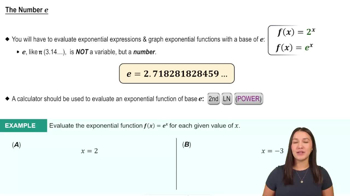
The Number e

The number e, approximately equal to 2.718, is a fundamental constant in mathematics, particularly in calculus. It serves as the base for natural logarithms and is significant in modeling continuous growth processes. The function e^x is unique because it is the only function that is its own derivative, making it a critical point of comparison for other exponential functions.
추천 영상:
4:47
The Number e

Growth Rate Comparison

To compare the growth rates of two exponential functions, we analyze their limits as x approaches infinity. Specifically, we can determine when b^x grows faster than e^x by examining the ratio of the two functions. If the limit of (b^x)/(e^x) approaches infinity as x increases, then b^x grows faster than e^x, which occurs when b > e.
추천 영상:
가이드 코스
04:16
Intro To Related Rates