Ch. 4 - Applications of the Derivative
Briggs - Calculus: Early Transcendentals 3rd Edition
Briggs3rd EditionCalculus: Early TranscendentalsISBN: 9780136847243당신이 사용하는 게 아니라요?교과서 변경
4장, 문제 119

Prove that lim_x→∞ (1 + a/x)ˣ = eᵃ , for a ≠ 0 .

검증된 단계별 안내
1
Step 1: Begin by understanding the expression (1 + a/x)^x. As x approaches infinity, the term a/x approaches 0, making the expression resemble (1 + 0)^x, which is 1^x = 1. However, the limit involves a more subtle behavior due to the exponent x.
Step 2: To analyze the limit, take the natural logarithm of the expression: ln((1 + a/x)^x) = x * ln(1 + a/x). This transformation helps simplify the expression by bringing the exponent down.
Step 3: Use the approximation ln(1 + u) ≈ u for small values of u. Here, u = a/x, which is small as x approaches infinity. Therefore, ln(1 + a/x) ≈ a/x.
Step 4: Substitute the approximation into the expression: x * ln(1 + a/x) ≈ x * (a/x) = a. This shows that the logarithm of the original expression approaches a as x approaches infinity.
Step 5: Since the natural logarithm of the expression approaches a, the original expression (1 + a/x)^x approaches e^a, because the exponential function is the inverse of the natural logarithm. Therefore, lim_x→∞ (1 + a/x)^x = e^a.

비슷한 문제에 대한 검증된 영상 답변:

이 영상 해법은 위 문제에 도움이 된다고 튜터들이 추천한 것입니다.
영상 길이:
5m
도움이 되었나요?

주요 개념

질문에 올바르게 답하기 위해 반드시 이해해야 하는 핵심 개념들은 다음과 같습니다.

Limits

In calculus, a limit describes the behavior of a function as its input approaches a certain value. In this case, we are interested in the limit as x approaches infinity. Understanding limits is crucial for analyzing the behavior of functions at extreme values and is foundational for concepts like continuity and derivatives.
추천 영상:
05:50
One-Sided Limits

Exponential Functions

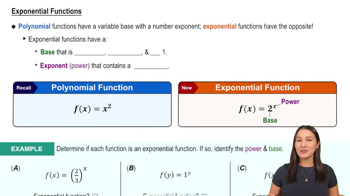
Exponential functions are mathematical functions of the form f(x) = e^x, where e is Euler's number (approximately 2.718). These functions are characterized by their constant growth rate, which is proportional to their current value. In the context of the limit, recognizing how the expression (1 + a/x)ˣ behaves as x increases is essential for proving the limit converges to eᵃ.
추천 영상:
6:13
Exponential Functions

The Definition of e

Euler's number e is defined as the limit of (1 + 1/n)ⁿ as n approaches infinity. This definition is fundamental in calculus and helps establish the relationship between exponential growth and limits. In the given limit, we can manipulate the expression to resemble this definition, allowing us to prove that lim_x→∞ (1 + a/x)ˣ converges to eᵃ.
추천 영상:
가이드 코스
05:43
Definition of the Definite Integral