Ch. 4 - Applications of the Derivative
Briggs - Calculus: Early Transcendentals 3rd Edition
Briggs3rd EditionCalculus: Early TranscendentalsISBN: 9780136847243당신이 사용하는 게 아니라요?교과서 변경
4장, 문제 101

Use limit methods to determine which of the two given functions grows faster, or state that they have comparable growth rates.
x²⁰ ; 1.0001ˣ

검증된 단계별 안내
1
Step 1: To compare the growth rates of the functions \( f(x) = x^{20} \) and \( g(x) = 1.0001^x \), we can use the concept of limits. Specifically, we will evaluate the limit of the ratio \( \frac{f(x)}{g(x)} \) as \( x \to \infty \).
Step 2: Set up the limit expression: \( \lim_{x \to \infty} \frac{x^{20}}{1.0001^x} \). This will help us determine which function grows faster.
Step 3: Analyze the behavior of the numerator \( x^{20} \) and the denominator \( 1.0001^x \) as \( x \to \infty \). The polynomial \( x^{20} \) grows at a polynomial rate, while the exponential function \( 1.0001^x \) grows at an exponential rate.
Step 4: Recall that exponential functions generally grow faster than polynomial functions as \( x \to \infty \). Therefore, we expect \( 1.0001^x \) to outpace \( x^{20} \) in growth.
Step 5: Conclude that if the limit \( \lim_{x \to \infty} \frac{x^{20}}{1.0001^x} = 0 \), then \( g(x) = 1.0001^x \) grows faster than \( f(x) = x^{20} \). If the limit were a non-zero constant, they would have comparable growth rates.

비슷한 문제에 대한 검증된 영상 답변:

이 영상 해법은 위 문제에 도움이 된다고 튜터들이 추천한 것입니다.
영상 길이:
5m
도움이 되었나요?

주요 개념

질문에 올바르게 답하기 위해 반드시 이해해야 하는 핵심 개념들은 다음과 같습니다.

Limits

Limits are fundamental in calculus, representing the value that a function approaches as the input approaches a certain point. They are crucial for analyzing the behavior of functions at infinity or near specific points, allowing us to determine growth rates and continuity. In this context, limits help compare the growth of the two functions as x approaches infinity.
추천 영상:
05:50
One-Sided Limits

Growth Rates

Growth rates describe how quickly a function increases as its input increases. In calculus, we often compare polynomial functions, like x²⁰, with exponential functions, like 1.0001ˣ, to determine which grows faster. Understanding the nature of these functions is essential for evaluating their limits and establishing their relative growth.
추천 영상:
가이드 코스
04:16
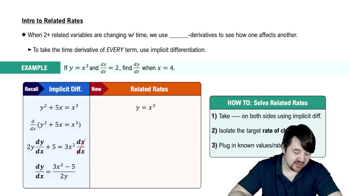
Intro To Related Rates

Asymptotic Behavior

Asymptotic behavior refers to the behavior of functions as the input approaches infinity. It helps in classifying functions based on their growth rates, indicating whether one function dominates another in terms of growth. Analyzing the asymptotic behavior of x²⁰ and 1.0001ˣ will reveal which function grows faster as x becomes very large.
추천 영상:
03:07
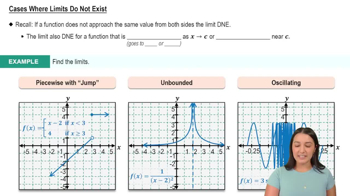
Cases Where Limits Do Not Exist