Ch. 4 - Applications of the Derivative
Briggs - Calculus: Early Transcendentals 3rd Edition
Briggs3rd EditionCalculus: Early TranscendentalsISBN: 9780136847243당신이 사용하는 게 아니라요?교과서 변경
4장, 문제 39

Use linear approximations to estimate the following quantities. Choose a value of a to produce a small error.
√146

검증된 단계별 안내
1
Identify the function you want to approximate. In this case, it's the square root function, f(x) = √x.
Choose a value of 'a' that is close to 146 and easy to compute. A good choice is a perfect square near 146, such as 144, because √144 = 12.
Find the derivative of the function f(x) = √x. The derivative is f'(x) = 1/(2√x).
Use the linear approximation formula: L(x) = f(a) + f'(a)(x - a). Substitute a = 144, f(144) = 12, and f'(144) = 1/(2√144) = 1/24.
Calculate L(146) using the formula: L(146) = 12 + (1/24)(146 - 144). This will give you an estimate for √146.

비슷한 문제에 대한 검증된 영상 답변:

이 영상 해법은 위 문제에 도움이 된다고 튜터들이 추천한 것입니다.
영상 길이:
4m
도움이 되었나요?

주요 개념

질문에 올바르게 답하기 위해 반드시 이해해야 하는 핵심 개념들은 다음과 같습니다.

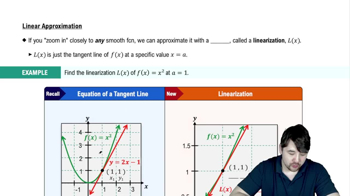
Linear Approximation

Linear approximation is a method used to estimate the value of a function near a given point using the tangent line at that point. It is based on the idea that a function can be closely approximated by a linear function when the input is near a specific value. The formula for linear approximation is f(a) + f'(a)(x - a), where f(a) is the function value at point a, and f'(a) is the derivative at that point.
추천 영상:

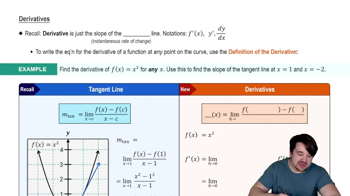
Derivative

The derivative of a function at a point measures the rate at which the function's value changes as its input changes. It is a fundamental concept in calculus that provides information about the slope of the tangent line to the function at that point. For the function f(x) = √x, the derivative can be calculated using the power rule, which helps in determining the linear approximation.
추천 영상:

Choosing a Value for a

Selecting an appropriate value for 'a' is crucial in linear approximation to minimize error. Ideally, 'a' should be a value close to the point of interest (in this case, 146) where the function is easy to compute. For estimating √146, a nearby perfect square, such as 144 (where √144 = 12), can be chosen to ensure that the linear approximation yields a small error.
추천 영상:
가이드 코스
06:37
Average Value of a Function