Ch. 4 - Applications of the Derivative
Briggs - Calculus: Early Transcendentals 3rd Edition
Briggs3rd EditionCalculus: Early TranscendentalsISBN: 9780136847243당신이 사용하는 게 아니라요?교과서 변경
4장, 문제 35

Use the guidelines of this section to make a complete graph of f.
f(x) = tan⁻¹ (x²/√3)

검증된 단계별 안내
1
Identify the domain of the function f(x) = tan⁻¹(x²/√3). Since the arctangent function is defined for all real numbers, the domain of f(x) is all real numbers.
Determine the symmetry of the function. Since f(x) involves x², which is an even function, f(x) is also an even function. This means the graph is symmetric with respect to the y-axis.
Find the critical points by taking the derivative of f(x) with respect to x. Use the chain rule to differentiate: f'(x) = (1/(1 + (x²/√3)²)) * (2x/√3). Set f'(x) = 0 to find critical points.
Analyze the behavior of f(x) as x approaches positive and negative infinity. Since the arctangent function approaches π/2 as its argument goes to infinity and -π/2 as its argument goes to negative infinity, f(x) will have horizontal asymptotes at y = π/2 and y = -π/2.
Plot key points and asymptotes on the graph. Use the symmetry, critical points, and asymptotic behavior to sketch the complete graph of f(x).

비슷한 문제에 대한 검증된 영상 답변:

이 영상 해법은 위 문제에 도움이 된다고 튜터들이 추천한 것입니다.
영상 길이:
13m
도움이 되었나요?

주요 개념

질문에 올바르게 답하기 위해 반드시 이해해야 하는 핵심 개념들은 다음과 같습니다.

Inverse Functions

Inverse functions, such as the arctangent function (tan⁻¹), reverse the effect of their corresponding functions. For example, if y = tan(x), then x = tan⁻¹(y). Understanding how to manipulate and graph inverse functions is crucial for analyzing the behavior of f(x) = tan⁻¹(x²/√3).
추천 영상:
4:49
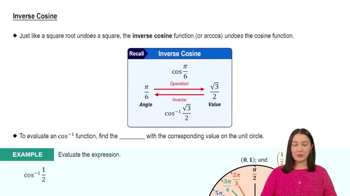
Inverse Cosine

Graphing Techniques

Graphing techniques involve plotting points, identifying asymptotes, and understanding the overall shape of a function. For f(x) = tan⁻¹(x²/√3), recognizing that the arctangent function has horizontal asymptotes at y = ±π/2 helps in sketching the graph accurately, especially as x approaches positive or negative infinity.
추천 영상:
가이드 코스
06:15
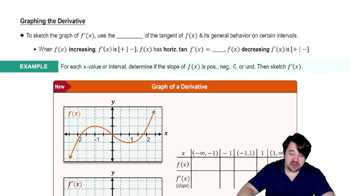
Graphing The Derivative

Transformations of Functions

Transformations of functions include shifts, stretches, and reflections that alter the graph of a function. In f(x) = tan⁻¹(x²/√3), the x² term indicates a vertical stretch and affects the symmetry of the graph, while the division by √3 scales the output. Understanding these transformations is essential for accurately graphing the function.
추천 영상:
가이드 코스
5:25
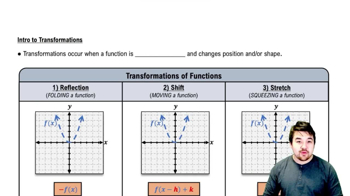
Intro to Transformations