Ch. 4 - Applications of the Derivative
Briggs - Calculus: Early Transcendentals 3rd Edition
Briggs3rd EditionCalculus: Early TranscendentalsISBN: 9780136847243당신이 사용하는 게 아니라요?교과서 변경
4장, 문제 4.8.19

{Use of Tech} Finding roots with Newton’s method For the given function f and initial approximation x₀, use Newton’s method to approximate a root of f. Stop calculating approximations when two successive approximations agree to five digits to the right of the decimal point after rounding. Show your work by making a table similar to that in Example 1.


f(x) = cos⁻¹ x - x; x₀ = 0.75

검증된 단계별 안내
1
Step 1: Understand Newton's Method. Newton's method is an iterative process used to find successively better approximations to the roots (or zeroes) of a real-valued function. The formula for Newton's method is: x=x-f(x)f'(x), where f'(x) is the derivative of f(x).
Step 2: Calculate the derivative of the function. Given f(x)=cos-1(x)-x, find f'(x). The derivative of cos-1(x) is -11-x2, and the derivative of x is 1. Therefore, f'(x)=-11-x2-1.
Step 3: Apply Newton's method using the initial approximation x=0.75. Substitute x=0.75 into the Newton's formula: x=0.75-f(0.75)f'(0.75). Calculate f(0.75) and f'(0.75).
Step 4: Compute the next approximation. Use the values from Step 3 to find the next approximation x=x-f(x)f'(x). Repeat this process iteratively, updating x each time.
Step 5: Continue iterations until two successive approximations agree to five decimal places. Create a table to track each iteration, showing the values of x, f(x), and f'(x) for each step. Stop when the difference between successive approximations is less than 0.00001.

비슷한 문제에 대한 검증된 영상 답변:

이 영상 해법은 위 문제에 도움이 된다고 튜터들이 추천한 것입니다.
영상 길이:
5m
도움이 되었나요?

주요 개념

질문에 올바르게 답하기 위해 반드시 이해해야 하는 핵심 개념들은 다음과 같습니다.

Newton's Method

Newton's Method is an iterative numerical technique used to find approximate roots of a real-valued function. It starts with an initial guess and refines it using the formula x₁ = x₀ - f(x₀)/f'(x₀), where f' is the derivative of f. This process continues until the difference between successive approximations is sufficiently small, indicating convergence to a root.
추천 영상:
가이드 코스
4:26
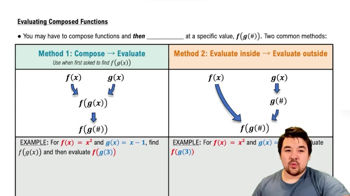
Evaluating Composed Functions

Convergence Criteria

In numerical methods, convergence criteria determine when to stop the iterative process. For Newton's Method, this often involves checking if the absolute difference between two successive approximations is less than a specified tolerance level, such as 0.00001 for five decimal places. This ensures that the approximations are accurate enough for practical purposes.
추천 영상:

Function and Derivative Evaluation

To apply Newton's Method, one must evaluate both the function f and its derivative f' at each iteration. For the given function f(x) = cos⁻¹ x - x, the derivative f'(x) = -1/√(1-x²) - 1 must be computed. Accurate evaluation of these functions is crucial for the method's success, as errors in these calculations can lead to incorrect approximations of the root.
추천 영상:
가이드 코스
4:26
Evaluating Composed Functions