
Ch. 4 - Applications of the Derivative
Briggs - Calculus: Early Transcendentals 3rd Edition
Briggs3rd EditionCalculus: Early TranscendentalsISBN: 9780136847243당신이 사용하는 게 아니라요?교과서 변경
4장, 문제 4.9.67

23–68. Indefinite integrals Determine the following indefinite integrals. Check your work by differentiation.


∫ (√x(2x⁶ - 4³√)dx

검증된 단계별 안내
1
Rewrite the integral to simplify the expression. Break down the terms inside the integral: \( \int \sqrt{x}(2x^6 - 4\sqrt[3]{x}) \, dx \). Recall that \( \sqrt{x} = x^{1/2} \) and \( \sqrt[3]{x} = x^{1/3} \). Distribute \( x^{1/2} \) across the terms inside the parentheses.
After distributing, the integral becomes \( \int (2x^{6 + 1/2} - 4x^{1/2 + 1/3}) \, dx \). Simplify the exponents by adding the powers: \( 6 + 1/2 = 13/2 \) and \( 1/2 + 1/3 = 3/6 + 2/6 = 5/6 \). The integral is now \( \int (2x^{13/2} - 4x^{5/6}) \, dx \).
Apply the power rule for integration: \( \int x^n \, dx = \frac{x^{n+1}}{n+1} + C \), where \( n \neq -1 \). Integrate each term separately. For the first term, \( 2x^{13/2} \), the new exponent is \( 13/2 + 1 = 15/2 \), and the coefficient becomes \( \frac{2}{15/2} = \frac{4}{15} \). For the second term, \( -4x^{5/6} \), the new exponent is \( 5/6 + 1 = 11/6 \), and the coefficient becomes \( \frac{-4}{11/6} = \frac{-24}{11} \).
Combine the results of the integration. The indefinite integral becomes \( \frac{4}{15}x^{15/2} - \frac{24}{11}x^{11/6} + C \), where \( C \) is the constant of integration.
Check your work by differentiating the result. Differentiate \( \frac{4}{15}x^{15/2} - \frac{24}{11}x^{11/6} + C \) term by term using the power rule for differentiation: \( \frac{d}{dx}x^n = nx^{n-1} \). Verify that the derivative matches the original integrand \( \sqrt{x}(2x^6 - 4\sqrt[3]{x}) \).

비슷한 문제에 대한 검증된 영상 답변:

이 영상 해법은 위 문제에 도움이 된다고 튜터들이 추천한 것입니다.
영상 길이:
3m
도움이 되었나요?

주요 개념

질문에 올바르게 답하기 위해 반드시 이해해야 하는 핵심 개념들은 다음과 같습니다.

Indefinite Integrals

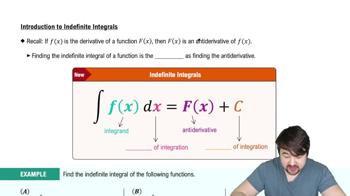
Indefinite integrals represent a family of functions whose derivative is the integrand. They are expressed with the integral sign and do not have specified limits, resulting in a general solution plus a constant of integration (C). Understanding how to compute indefinite integrals is crucial for solving problems in calculus, as they are foundational to the concept of antiderivatives.
추천 영상:
가이드 코스
05:04
Introduction to Indefinite Integrals

Integration Techniques

Various techniques are used to evaluate integrals, including substitution, integration by parts, and recognizing standard forms. For the given integral, recognizing the structure of the integrand, such as factoring or simplifying expressions, can facilitate the integration process. Mastery of these techniques is essential for effectively solving more complex integrals.
추천 영상:
가이드 코스
06:18
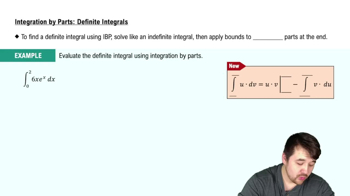
Integration by Parts for Definite Integrals

Verification by Differentiation

After finding an indefinite integral, it is important to verify the result by differentiating the antiderivative obtained. This process ensures that the derivative of the antiderivative returns to the original integrand. This verification step is a critical part of the integration process, confirming the accuracy of the solution and reinforcing the relationship between differentiation and integration.
추천 영상:
가이드 코스
05:53
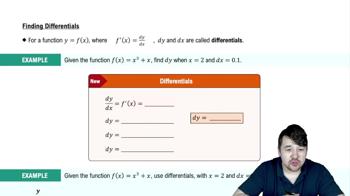
Finding Differentials