
Ch. 4 - Applications of the Derivative
Briggs - Calculus: Early Transcendentals 3rd Edition
Briggs3rd EditionCalculus: Early TranscendentalsISBN: 9780136847243당신이 사용하는 게 아니라요?교과서 변경
4장, 문제 4.3.58

Verify that the following functions satisfy the conditions of Theorem 4.9 on their domains. Then find the location and value of the absolute extrema guaranteed by the theorem.


f(x) = x√(3-x)

검증된 단계별 안내
1
Theorem 4.9 refers to the Extreme Value Theorem, which states that if a function is continuous on a closed interval [a, b], then it must attain a maximum and a minimum value, at least once, on that interval.
First, identify the domain of the function f(x) = x√(3-x). The expression under the square root, 3-x, must be non-negative, so x must be less than or equal to 3. Therefore, the domain is [0, 3].
Verify that f(x) is continuous on the interval [0, 3]. Since f(x) is a product of a polynomial (x) and a square root function (√(3-x)), both of which are continuous on [0, 3], f(x) is continuous on this interval.
To find the absolute extrema, calculate the derivative f'(x) using the product rule. Let u = x and v = √(3-x). Then, f'(x) = u'v + uv'. Compute u' = 1 and v' using the chain rule: v' = -1/(2√(3-x)).
Set f'(x) = 0 to find critical points. Solve the equation 1√(3-x) + x(-1/(2√(3-x))) = 0. Simplify and solve for x to find the critical points within the interval [0, 3]. Evaluate f(x) at these critical points and at the endpoints x = 0 and x = 3 to determine the absolute extrema.

비슷한 문제에 대한 검증된 영상 답변:

이 영상 해법은 위 문제에 도움이 된다고 튜터들이 추천한 것입니다.
영상 길이:
10m

주요 개념

질문에 올바르게 답하기 위해 반드시 이해해야 하는 핵심 개념들은 다음과 같습니다.

Theorem 4.9 (Extreme Value Theorem)

The Extreme Value Theorem states that if a function is continuous on a closed interval [a, b], then it attains both a maximum and a minimum value at least once within that interval. This theorem is crucial for identifying absolute extrema, as it provides the conditions under which these extrema exist.
추천 영상:
가이드 코스
06:11
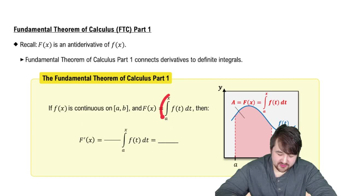
Fundamental Theorem of Calculus Part 1

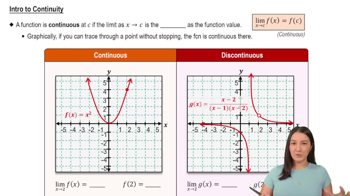
Continuity of Functions

A function is continuous if there are no breaks, jumps, or holes in its graph. For the Extreme Value Theorem to apply, the function must be continuous on the specified interval. Understanding continuity helps in determining the appropriate intervals for analysis and ensures that the function behaves predictably.
추천 영상:
05:34
Intro to Continuity

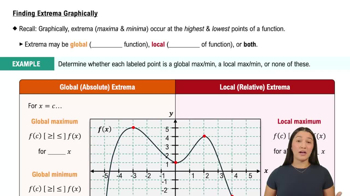
Finding Extrema

To find the absolute extrema of a function, one must evaluate the function at critical points (where the derivative is zero or undefined) and at the endpoints of the interval. This process involves calculating the derivative, setting it to zero to find critical points, and then comparing the function values at these points and the endpoints to determine the maximum and minimum values.
추천 영상:
05:58
Finding Extrema Graphically