Ch. 4 - Applications of the Derivative
Briggs - Calculus: Early Transcendentals 3rd Edition
Briggs3rd EditionCalculus: Early TranscendentalsISBN: 9780136847243당신이 사용하는 게 아니라요?교과서 변경
4장, 문제 4.7.25

Evaluate the following limits. Use l’Hôpital’s Rule when it is convenient and applicable.
lim_x→ e (ln x - 1) / (x - 1)

검증된 단계별 안내
1
First, identify the form of the limit as x approaches e. Substitute x = e into the expression (ln x - 1) / (x - 1). You will find that both the numerator and the denominator approach 0, which is an indeterminate form 0/0.
Since the limit is in the indeterminate form 0/0, l'Hôpital's Rule can be applied. According to l'Hôpital's Rule, if the limit of f(x)/g(x) as x approaches a is in the form 0/0 or ∞/∞, then the limit can be found by taking the derivative of the numerator and the derivative of the denominator.
Differentiate the numerator ln(x) - 1 with respect to x. The derivative of ln(x) is 1/x, and the derivative of the constant -1 is 0. Therefore, the derivative of the numerator is 1/x.
Differentiate the denominator x - 1 with respect to x. The derivative of x is 1, and the derivative of the constant -1 is 0. Therefore, the derivative of the denominator is 1.
Apply l'Hôpital's Rule by substituting the derivatives into the limit expression. The limit becomes lim_x→e (1/x) / 1. Simplify this expression to lim_x→e 1/x. Now, substitute x = e into the simplified expression to evaluate the limit.

비슷한 문제에 대한 검증된 영상 답변:

이 영상 해법은 위 문제에 도움이 된다고 튜터들이 추천한 것입니다.
영상 길이:
8m
도움이 되었나요?

주요 개념

질문에 올바르게 답하기 위해 반드시 이해해야 하는 핵심 개념들은 다음과 같습니다.

Limits

Limits are fundamental in calculus, representing the value that a function approaches as the input approaches a certain point. They are essential for understanding continuity, derivatives, and integrals. In this question, evaluating the limit as x approaches e involves determining the behavior of the function ln(x) - 1 over x - 1 near that point.
추천 영상:
05:50
One-Sided Limits

l'Hôpital's Rule

l'Hôpital's Rule is a method for evaluating limits that result in indeterminate forms, such as 0/0 or ∞/∞. It states that if the limit of f(x)/g(x) leads to an indeterminate form, the limit can be found by taking the derivative of the numerator and the derivative of the denominator. This rule is particularly useful in the given limit problem when direct substitution leads to an indeterminate form.
추천 영상:
5:50
Power Rules

Natural Logarithm

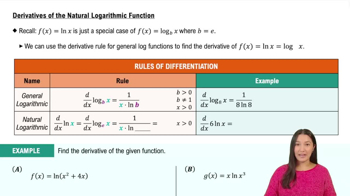
The natural logarithm, denoted as ln(x), is the logarithm to the base e, where e is approximately 2.71828. It is a crucial function in calculus, especially in limits and derivatives, due to its unique properties, such as ln(e) = 1 and its derivative being 1/x. In this limit problem, understanding the behavior of ln(x) as x approaches e is key to solving the limit.
추천 영상:
05:18
Derivative of the Natural Logarithmic Function
관련 실천
교과서 질문

Verify that the following functions satisfy the conditions of Theorem 4.9 on their domains. Then find the location and value of the absolute extrema guaranteed by the theorem.


f(x) = x√(3-x)

184
views

교과서 질문

23–68. Indefinite integrals Determine the following indefinite integrals. Check your work by differentiation.


∫ (sec² Θ + sec Θ tan Θ)dΘ

105
views
교과서 질문

Given a function f that is differentiable on its domain, write and explain the relationship between the differentials dx and dy.

252
views
교과서 질문

Avalanche forecasting Avalanche forecasters measure the temperature gradient dT/dh, which is the rate at which the temperature in a snowpack T changes with respect to its depth h. A large temperature gradient may lead to a weak layer in the snowpack. When these weak layers collapse, avalanches occur. Avalanche forecasters use the following rule of thumb: If dT/dh exceeds 10° C/m anywhere in the snowpack, conditions are favorable for weak-layer formation, and the risk of avalanche increases. Assume the temperature function is continuous and differentiable.


a. An avalanche forecaster digs a snow pit and takes two temperature measurements. At the surface (h = 0), the temperature is -16° C. At a depth of 1.1 m, the temperature is -2° C. Using the Mean Value Theorem, what can he conclude about the temperature gradient? Is the formation of a weak layer likely?

176
views
교과서 질문

Graphing functions Use the guidelines of this section to make a complete graph of f.


f(x) = 1/(e⁻ˣ - 1)

160
views
교과서 질문

Locating critical points Find the critical points of the following functions. Assume a is a nonzero constant.


ƒ(x) = eˣ + e⁻ˣ

213
views