Ch. 5 - Integration
Briggs - Calculus: Early Transcendentals 3rd Edition
Briggs3rd EditionCalculus: Early TranscendentalsISBN: 9780136847243당신이 사용하는 게 아니라요?교과서 변경
5장, 문제 5.R.23d

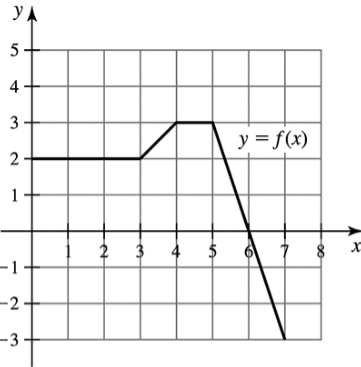
Area by geometry Use geometry to evaluate the following definite integrals, where the graph of ƒ is given in the figure.


(d) ∫₀⁷ ƒ(𝓍) d𝓍
Graph of a function showing a piecewise linear shape, with axes labeled x and y, illustrating definite integrals.

검증된 단계별 안내
1
Step 1: Observe the graph of the function ƒ(x) provided. The graph is piecewise linear, meaning it consists of straight-line segments. To evaluate the definite integral ∫₀⁷ ƒ(x) dx using geometry, we need to calculate the areas of the geometric shapes formed between the graph and the x-axis over the interval [0, 7].
Step 2: Break the interval [0, 7] into subintervals based on where the function changes behavior. From the graph, the function changes at x = 0, x = 3, x = 5, and x = 7. Identify the shapes formed in each subinterval: rectangles and triangles.
Step 3: Calculate the area of each shape. For the interval [0, 3], the graph forms a rectangle with height 2 and width 3. For the interval [3, 5], the graph forms a trapezoid (or two triangles stacked) with heights 2 and 3 and width 2. For the interval [5, 7], the graph forms a triangle below the x-axis with base 2 and height -3.
Step 4: Use the formula for the area of a rectangle (Area = base × height) and the formula for the area of a triangle (Area = 0.5 × base × height) to compute the areas of each shape. Remember to account for the sign of the area: areas above the x-axis are positive, and areas below the x-axis are negative.
Step 5: Add the areas of all the shapes together to find the total area under the curve from x = 0 to x = 7. This sum represents the value of the definite integral ∫₀⁷ ƒ(x) dx.

비슷한 문제에 대한 검증된 영상 답변:

이 영상 해법은 위 문제에 도움이 된다고 튜터들이 추천한 것입니다.
영상 길이:
7m
도움이 되었나요?

주요 개념

질문에 올바르게 답하기 위해 반드시 이해해야 하는 핵심 개념들은 다음과 같습니다.

Definite Integral

A definite integral represents the signed area under a curve between two points on the x-axis. It is calculated using the limits of integration, which define the interval over which the area is measured. In this context, the definite integral ∫₀⁷ ƒ(𝓍) d𝓍 calculates the total area between the graph of the function ƒ and the x-axis from x = 0 to x = 7.
추천 영상:
가이드 코스
05:43
Definition of the Definite Integral

Area Under the Curve

The area under the curve of a function can be interpreted geometrically as the total area between the curve and the x-axis. This area can be positive or negative depending on whether the curve is above or below the x-axis. In the given problem, the graph shows a piecewise linear function, which allows for straightforward geometric calculations of the areas of rectangles and triangles.
추천 영상:
가이드 코스
05:59
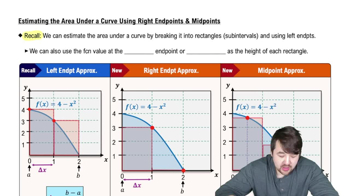
Estimating the Area Under a Curve with Right Endpoints & Midpoint

Piecewise Function

A piecewise function is defined by different expressions or formulas over different intervals of its domain. In this case, the function ƒ(𝓍) is represented by linear segments across specified intervals. Understanding how to evaluate the function at different segments is crucial for accurately calculating the definite integral, as each segment contributes differently to the total area.
추천 영상:
가이드 코스
05:36
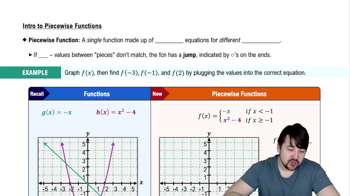
Piecewise Functions
관련 실천
교과서 질문

Area versus net area Find (i) the net area and (ii) the area of the region bounded by the graph of ƒ and the 𝓍-axis on the given interval. You may find it useful to sketch the region.

ƒ(𝓍) = 𝓍⁴ ― 𝓍² on [―1, 1]

152
views

교과서 질문

Area functions and the Fundamental Theorem Consider the function

ƒ(t) = { t      if  ―2 ≤ t < 0

t²/2    if    0 ≤ t ≤ 2

and its graph shown below. Let F(𝓍) = ∫₋₁ˣ ƒ(t) dt and G(𝓍) = ∫₋₂ˣ ƒ(t) dt.                                                                                                               


(a) Evaluate F(―2) and F(2).

94
views
교과서 질문

Evaluating integrals Evaluate the following integrals.


∫₁⁴ ((√v + v) / v ) dv

70
views
교과서 질문

Change of variables Use the change of variables u³ = 𝓍² ― 1 to evaluate the integral ∫₁³ 𝓍∛(𝓍²―1) d𝓍 .

165
views
교과서 질문

Area functions and the Fundamental Theorem Consider the function

ƒ(t) = { t      if  ―2 ≤ t < 0

t²/2    if    0 ≤ t ≤ 2

and its graph shown below. Let F(𝓍) = ∫₋₁ˣ ƒ(t) dt and G(𝓍) = ∫₋₂ˣ ƒ(t) dt.

(d) Evaluate F ' (―1) and F ' (1). Interpret these values.

78
views
교과서 질문

Integration by Riemann sums Consider the integral ∫₁⁴ (3𝓍― 2) d𝓍.


(a) Evaluate the right Riemann sum for the integral with n = 3 .

85
views