Ch. 5 - Integration
Briggs - Calculus: Early Transcendentals 3rd Edition
Briggs3rd EditionCalculus: Early TranscendentalsISBN: 9780136847243당신이 사용하는 게 아니라요?교과서 변경
5장, 문제 5.R.105d

Area functions and the Fundamental Theorem Consider the function
ƒ(t) = { t      if  ―2 ≤ t < 0
t²/2    if    0 ≤ t ≤ 2
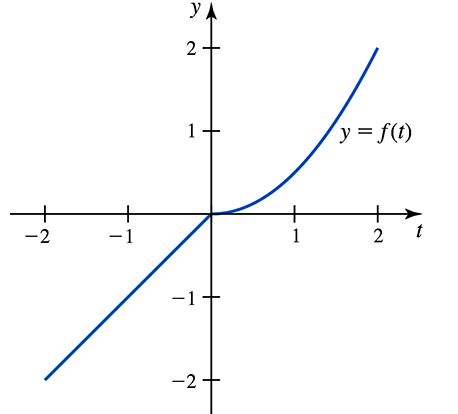
and its graph shown below. Let F(𝓍) = ∫₋₁ˣ ƒ(t) dt and G(𝓍) = ∫₋₂ˣ ƒ(t) dt.

(d) Evaluate F ' (―1) and F ' (1). Interpret these values.

검증된 단계별 안내
1
Step 1: Recall the Fundamental Theorem of Calculus, which states that if F(x) = ∫ₐˣ ƒ(t) dt, then F'(x) = ƒ(x). This means the derivative of the area function F(x) is equal to the value of the function ƒ(x) at x.
Step 2: To evaluate F'(−1), observe that F'(x) = ƒ(x). From the graph and the piecewise definition of ƒ(t), for −2 ≤ t < 0, ƒ(t) = t. Therefore, ƒ(−1) = −1.
Step 3: To evaluate F'(1), observe again that F'(x) = ƒ(x). From the graph and the piecewise definition of ƒ(t), for 0 ≤ t ≤ 2, ƒ(t) = t²/2. Therefore, ƒ(1) = (1²)/2 = 1/2.
Step 4: Interpret the values: F'(−1) = −1 indicates that at x = −1, the rate of change of the area function F(x) is equal to the value of ƒ(t) at t = −1, which is −1. Similarly, F'(1) = 1/2 indicates that at x = 1, the rate of change of the area function F(x) is equal to the value of ƒ(t) at t = 1, which is 1/2.
Step 5: The values of F'(−1) and F'(1) provide insight into how the function ƒ(t) contributes to the accumulation of area in F(x) at specific points. Negative values of ƒ(t) (e.g., at t = −1) reduce the accumulated area, while positive values (e.g., at t = 1) increase it.

비슷한 문제에 대한 검증된 영상 답변:

이 영상 해법은 위 문제에 도움이 된다고 튜터들이 추천한 것입니다.
영상 길이:
3m
도움이 되었나요?

주요 개념

질문에 올바르게 답하기 위해 반드시 이해해야 하는 핵심 개념들은 다음과 같습니다.

Fundamental Theorem of Calculus

The Fundamental Theorem of Calculus links the concept of differentiation and integration, stating that if F is an antiderivative of f on an interval [a, b], then the integral of f from a to b is equal to F(b) - F(a). This theorem allows us to evaluate definite integrals and understand the relationship between a function and its area under the curve.
추천 영상:
가이드 코스
06:11
Fundamental Theorem of Calculus Part 1

Derivative of an Integral Function

When evaluating the derivative of an integral function, such as F(x) = ∫₋₁ˣ f(t) dt, we apply the Fundamental Theorem of Calculus. The derivative F'(x) gives us the value of the integrand f evaluated at the upper limit of integration, which provides insight into the rate of change of the area under the curve as x varies.
추천 영상:
05:11
Integrals of General Exponential Functions

Piecewise Functions

A piecewise function is defined by different expressions based on the input value. In this case, the function f(t) has two distinct expressions depending on whether t is less than 0 or between 0 and 2. Understanding how to evaluate and differentiate piecewise functions is crucial for correctly applying calculus concepts to such functions.
추천 영상:
가이드 코스
05:36
Piecewise Functions
관련 실천
교과서 질문

Area versus net area Find (i) the net area and (ii) the area of the region bounded by the graph of ƒ and the 𝓍-axis on the given interval. You may find it useful to sketch the region.

ƒ(𝓍) = 𝓍⁴ ― 𝓍² on [―1, 1]

152
views

교과서 질문

Area functions and the Fundamental Theorem Consider the function

ƒ(t) = { t      if  ―2 ≤ t < 0

t²/2    if    0 ≤ t ≤ 2

and its graph shown below. Let F(𝓍) = ∫₋₁ˣ ƒ(t) dt and G(𝓍) = ∫₋₂ˣ ƒ(t) dt.                                                                                                               


(a) Evaluate F(―2) and F(2).

94
views
교과서 질문

Evaluating integrals Evaluate the following integrals.


∫π/₁₂^π/⁹ (csc 3𝓍 cot 3𝓍 + sec 3𝓍 tan 3𝓍) d𝓍

42
views
교과서 질문

Integration by Riemann sums Consider the integral ∫₁⁴ (3𝓍― 2) d𝓍.


(a) Evaluate the right Riemann sum for the integral with n = 3 .

85
views
교과서 질문

Area by geometry Use geometry to evaluate the following definite integrals, where the graph of ƒ is given in the figure.


(d) ∫₀⁷ ƒ(𝓍) d𝓍

56
views
교과서 질문

Evaluating integrals Evaluate the following integrals.                                                                                                                                         


 ∫ y² (3y³ + 1)⁴ dy

70
views